A dust collector can meet its nameplate airflow and still fail the plant. Poor capture, rising pressure drop, damaged media, dust discharge during hopper cleanout, or an unaddressed combustible-dust hazard can turn a filtration purchase into a production and compliance issue. The question of pulse-jet versus cartridge collector is therefore not simply about choosing one machine over another. It starts with defining the dust, the process duty, the available footprint, and the performance evidence required after commissioning.
There is also a technical distinction that matters during procurement. Pulse-jet cleaning is a method, not a filter-media shape. Both baghouse collectors and cartridge collectors can use compressed-air pulse-jet cleaning. In most plant discussions, the intended comparison is a pulse-jet bag collector versus a cartridge dust collector. Making that distinction early prevents incorrect equipment specifications and unrealistic operating expectations.
Pulse-Jet Versus Cartridge Collector: The Practical Difference
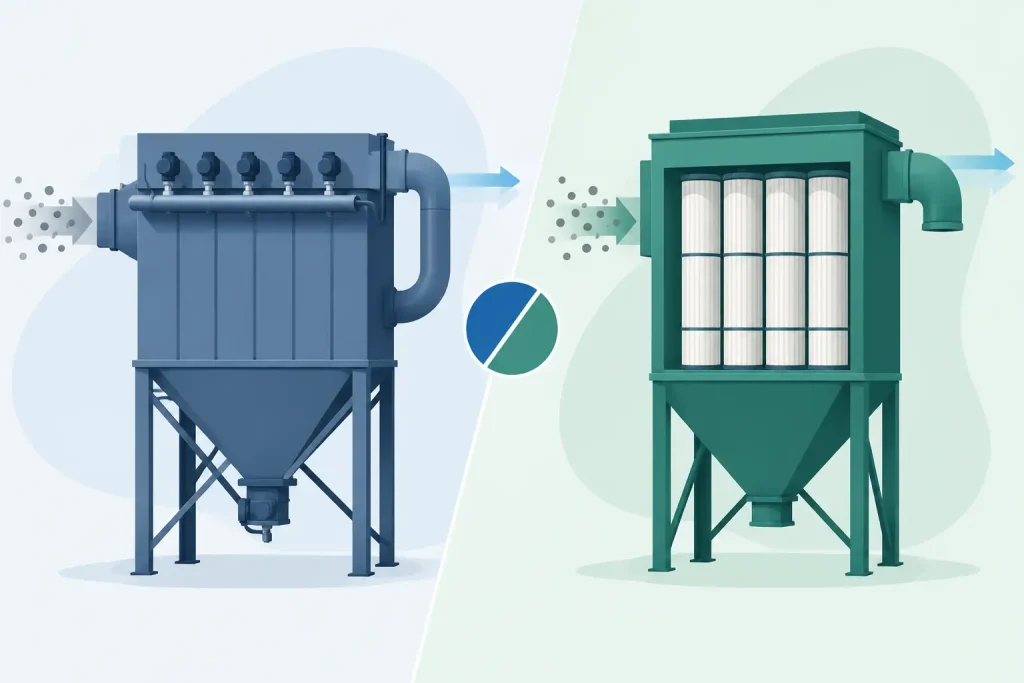
A pulse-jet bag collector uses long cylindrical filter bags installed over cages. Dust-laden air enters the collector, particulate is retained on the bag surface, and short bursts of compressed air dislodge accumulated dust into hoppers below. These systems are commonly selected for high dust volumes, continuous-duty processes, and applications where the particulate loading is too heavy for a compact cartridge arrangement.
A cartridge collector uses pleated filter cartridges. Pleating provides a large filtration area within a relatively small housing, making cartridge units attractive where floor space is constrained and dust loading is moderate. They are widely used for metalworking, welding, plasma and laser cutting, powder handling, pharmaceutical processing, and other applications involving dry, fine particulate.
Neither design is automatically better. A cartridge collector may offer a compact footprint and straightforward cartridge replacement, but it can be the wrong choice for bulky, fibrous, sticky, or very high-loading dust. A bag collector may tolerate demanding process conditions well, but it generally needs more structural space and can require more attention during bag and cage replacement.
Start With the Dust, Not the Collector Catalog
The dust characteristics should govern the selection. Particle size alone is not enough. The engineering review should consider bulk density, particle shape, moisture sensitivity, abrasiveness, temperature, cohesiveness, and whether the dust tends to bridge in a hopper or cling to filter media.
Fine, dry, free-flowing dust often suits cartridge filtration, particularly where a high filtration area is needed within a limited footprint. Fine metal dust from grinding or cutting may be effectively handled by cartridges when the collector is properly sized, fitted with suitable media, and supported by effective spark management and explosion protection where required.
High-volume or heavy particulate applications often point toward pulse-jet bag collectors. Examples include foundry operations, mineral processing, bulk material transfer, wood dust collection, animal feed processing, and certain boiler or thermal process applications. Long bags can provide a practical arrangement for handling substantial dust loads while allowing collected material to fall into a hopper.
Fibrous dust deserves special caution. Materials that are stringy, fluffy, or prone to matting can lodge in cartridge pleats and make pulse cleaning less effective. Sticky dust creates a similar problem, particularly when moisture, oil mist, or condensation is present. In these cases, the issue is not merely shorter filter life. The collector may experience rapid pressure-drop increase, reduced airflow at pickup points, and repeated maintenance interruptions.
Air-to-Media Ratio Determines Filter Life
The air-to-media ratio is one of the most useful design checks in collector selection. It describes how much air passes through each square foot of filter media. A ratio that is too high can drive dust deep into the media, increase differential pressure, and shorten filter life. A ratio that is unnecessarily low can result in an oversized capital investment.
Cartridge collectors often contain extensive media area because of their pleated design. However, advertised media area does not eliminate the need to assess usable area under actual dust conditions. If dust packs into pleats, the effective filtration area can decrease quickly. Media selection, pulse-cleaning pressure, cleaning frequency, and the collector’s internal airflow pattern must work together.
Bag collectors use different media geometry and may be more forgiving in applications with heavier dust release. The selected fabric, surface treatment, permeability, and bag length all influence performance. For fine particulate, membrane-laminated or surface-filtration media may be appropriate because it allows dust cake release closer to the media surface. For abrasive dust, durable media and appropriate inlet design are essential.
A sound design should state the expected clean and dirty pressure-drop range, required compressed-air quality and pressure, fan static pressure, and target airflow at every hood or pickup point. Without these values, a collector specification is incomplete.
Footprint and Maintenance Access Change the Answer
Cartridge collectors are often selected because they fit well beside a production line or within a constrained utility area. Their compact form can reduce duct length and simplify installation. This advantage is meaningful only if maintenance access remains practical. Technicians need safe room to remove cartridges, inspect pulse valves, service solenoids, empty dust containers, and verify differential-pressure instrumentation.
A pulse-jet bag collector usually demands more vertical clearance and a larger foundation area. Yet larger access space can be an operational advantage for a plant that expects frequent inspection or handles significant dust quantities. Hopper geometry, rotary airlocks, screw conveyors, and discharge bins must be designed around how material will actually be removed. A hopper that cannot discharge reliably can cause dust buildup inside the collector and affect filter performance.
Maintenance planning should also consider downtime. Cartridge changeout can be efficient, but frequent cartridge replacement is costly and exposes personnel to collected dust. Bag replacement may take longer, especially for large collectors, but properly selected bags can offer long service life under stable process conditions. The right comparison is lifecycle cost per operating hour, not only purchase price or the cost of one replacement element.
Compliance Depends on the Entire System
A collector does not provide compliance by itself. The hood, ductwork, fan, discharge arrangement, and monitoring points determine whether the system captures and controls the emission source as designed. A collector can show low outlet emissions while inadequate hood capture allows dust to remain in the work area.
For US facilities, the applicable requirements may involve OSHA worker-exposure obligations, EPA air-permit conditions, state or local air-quality rules, and site-specific reporting requirements. Where combustible particulate is present, the plant should also evaluate applicable NFPA standards and conduct a dust hazards analysis. Aluminum, magnesium, wood, coal, organic powders, plastics, and many metal or food dusts can present fire or explosion risks under the wrong conditions.
Explosion vents, flameless venting, isolation devices, suppression systems, grounding, spark detection, and fire protection are not universal add-ons. Their need depends on the dust’s explosibility data, collector location, occupancy, duct layout, and process configuration. These safeguards must be engineered as part of the system, not added after a near miss.
Testing and commissioning should verify airflow, hood capture performance, static pressure, fan rotation, pulse-cleaning operation, hopper discharge, and visible leakage. Differential-pressure trending provides an early indication of blocked media, failed pulse valves, compressed-air issues, or abnormal process loading. Stack sampling or emissions testing may be required to establish compliance with permit limits and provide defensible operating records.
A Selection Process That Reduces Rework
The most reliable selection process begins with a field audit rather than a catalog comparison. Engineers should document each emission point, process operating mode, material handled, production schedule, existing duct configuration, and available installation space. The review should include representative dust samples and, where needed, laboratory information on particle size, moisture behavior, abrasiveness, and explosibility.
Next, establish the design airflow from capture requirements, not from the collector inlet size. This requires evaluating hood geometry, duct transport velocity, balancing needs, and fan static pressure. The filter unit is then sized around the real airflow, dust loading, air-to-media ratio, and required emission performance.
Finally, specify serviceability and verification requirements before equipment fabrication begins. This includes access platforms, safe filter-change methods, hopper discharge equipment, instrumentation, spare parts, control-panel alarms, and acceptance testing. Plants that include these details in the original scope avoid costly modifications after startup.
When Each Collector Is Usually the Better Fit
A cartridge collector is often the stronger choice for dry, fine to moderate dust loads where space is limited and the process benefits from a compact, high-media-area system. It is particularly common at localized metalworking stations, cutting tables, polishing operations, and enclosed powder-handling points.
A pulse-jet bag collector is often the stronger choice for continuous, high-volume, heavy-loading, fibrous, or abrasive dust applications. It is frequently suited to central collection systems, bulk handling, foundry work, feed processing, woodworking, and process areas where durable material discharge is as important as filtration efficiency.
The final decision should be based on measured process conditions and a design that can be tested, commissioned, and maintained. Master Jaya Group approaches dust collection as a full clean-air system, combining engineered equipment with field auditing, testing and commissioning, stack sampling, and ongoing performance monitoring.
Choose the collector that keeps capture airflow stable on an ordinary production shift, allows safe maintenance when filters are due, and produces records your plant can rely on when compliance performance is questioned.