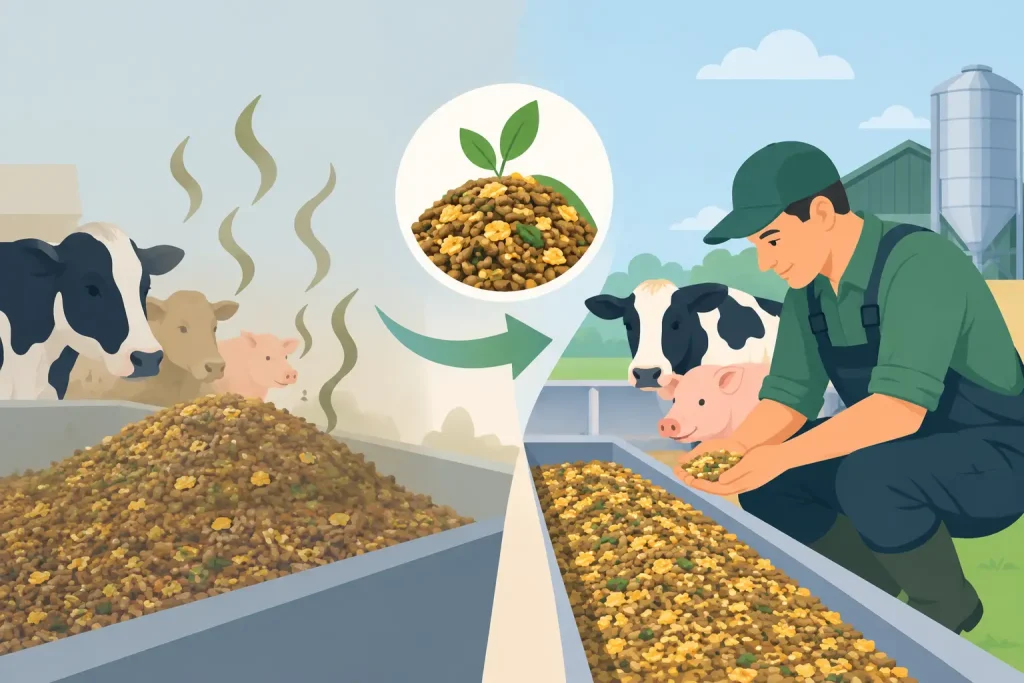
A feed mill can meet production targets and still create a serious community and compliance problem when odor escapes from receiving, grinding, mixing, pelleting, cooling, or finished-product handling. This animal feed odor case study examines a representative engineering scenario in which recurring off-site complaints were traced not to one stack, but to several poorly controlled process points operating across different shifts.
The project demonstrates a point that plant managers often encounter too late: odor control is not simply a matter of installing a larger fan or adding a chemical treatment unit. Effective control begins with defining the odor sources, quantifying airflow, maintaining negative pressure where it matters, and selecting treatment technology that suits the actual contaminants and operating profile.
Animal Feed Odor Case Study: The Operating Problem
The facility produced pelleted livestock feed using grain, protein meal, molasses, fats, minerals, and nutritional additives. The most persistent odor reports occurred during raw-material unloading, ingredient batching, pellet cooling, and periodic cleanout activities. Operators also reported dust accumulation around transfer points and inconsistent suction at several hoods.
Initial assumptions focused on the pellet cooler exhaust because it had a visible discharge point and a noticeable warm odor plume. Field auditing showed a more complex picture. The cooler was a contributor, but fugitive emissions from open conveyors, leaking duct joints, insufficient hood capture, and building openings allowed odor-laden air to bypass the existing treatment system entirely.
This distinction matters. An end-of-pipe system cannot control contaminated air that is never captured. Increasing the capacity of the existing fan would have increased airflow demand, but it would not have corrected poorly designed hoods, air leakage, or uneven branch balancing.
Why odor was inconsistent
Animal feed odor can vary considerably by formulation and process condition. High-protein materials, fish meal, fats, molasses, fermentation residues, and overheated product can each produce different odor characteristics. Moisture, material residence time, and cleaning frequency also influence the result.
At this facility, complaints increased when the production schedule shifted to formulations containing stronger-smelling protein ingredients. The existing ventilation system had been sized around normal dust extraction requirements, not around the combined challenge of warm, moisture-laden air and odor compounds released during pelleting and cooling.
The engineering objective was therefore twofold: improve local capture to reduce indoor worker exposure and fugitive release, then treat the collected air before discharge.
Field Auditing Before Equipment Selection
A reliable odor-control project should begin with evidence, not a catalog selection. The audit included a process walkthrough, hood and duct inspection, airflow measurements, static-pressure checks, fan condition review, and an assessment of operating practices during peak odor events.
The survey identified four main deficiencies. Several hoods were positioned too far from emission points. Duct velocities varied significantly between branches, causing some locations to pull excessive air while others had weak suction. Door openings near the cooler created cross-drafts that disrupted capture. Finally, the existing dust collector reduced particulate emissions but was not designed to remove gaseous odor compounds.
Dust collection remains necessary in feed processing because particulate control protects equipment, improves housekeeping, and reduces combustible-dust exposure. However, a pulse-jet dust collector should not be expected to solve an odor problem on its own. The separation of dust-control duty from gas-treatment duty is often the correct engineering approach.
Airflow requirements were recalculated based on hood geometry, open-face area, distance from the source, process temperature, and the need to maintain effective conveyance velocity in the ductwork. This allowed the project team to distinguish between air that needed treatment and excess dilution air that would unnecessarily increase capital cost, fan power, and scrubber size.
The Selected Odor-Control Configuration
The final concept used enclosed source capture at the highest-emission points, followed by staged air-pollution-control equipment. Dust-laden air first passed through a pulse-jet dust collector to remove entrained particulate. The cleaner air stream was then directed to a packed tower scrubber selected for the anticipated odor chemistry and moisture load.
A packed tower scrubber is not a universal answer to every feed odor. Its suitability depends on the odor-causing compounds, gas temperature, inlet particulate level, required removal efficiency, chemical compatibility, and wastewater-management capability. In this case, the scrubber was selected because the collected air contained water-soluble and chemically treatable odor components, and the facility had the operational capacity to manage recirculating liquor, dosing, pH control, and blowdown.
For facilities with a high proportion of non-water-soluble volatile organic compounds, activated carbon filtration or thermal oxidation may be more appropriate. Carbon can be highly effective for lower-flow, relatively clean gas streams, but media replacement and fire risk require careful planning. Regenerative thermal oxidizers may achieve high destruction efficiency for suitable VOC loads, but fuel consumption and process economics must be evaluated. The right solution depends on the source profile, not on a single technology preference.
Capture improvements were the critical first step
The project scope included redesigned receiving and transfer-point enclosures, revised hood locations, flexible curtains at selected openings, and duct modifications to reduce pressure losses. Manual balancing dampers and measurement ports were incorporated so future servicing could verify actual system performance rather than relying on operator perception.
A variable-frequency drive was specified for the induced-draft fan. This gave the facility the ability to maintain target static pressure as production conditions changed, while avoiding continuous full-speed operation during lower-load periods. The control arrangement also included interlocks so that odor-generating process equipment could not operate without the extraction and treatment system running.
Testing, Commissioning, and Performance Verification
Installation alone does not establish compliance or performance. During testing and commissioning, the system was checked for fan rotation, motor load, duct leakage, hood capture, airflow distribution, pump performance, scrubber pressure drop, recirculation rate, and chemical-dosing response.
The team then conducted operational testing during representative production, including the formulation associated with the strongest odor complaints. Airflow readings confirmed that suction at previously weak hoods had improved. Building negative pressure was stabilized in the targeted production zones, reducing escape through doors and gaps. The dust collector also operated at a controlled differential pressure, helping prevent dust carryover to downstream equipment.
For a compliance-led project, documentation is as important as the installed hardware. The facility retained commissioning records, airflow and pressure readings, operating setpoints, preventive-maintenance requirements, chemical-handling procedures, and corrective-action guidance. Where required by the applicable authority or permit, stack sampling and formal reporting can provide defensible evidence of system performance.
Odor itself is not always regulated through a single numerical stack limit. Local permits, nuisance provisions, environmental agency requirements, and community expectations can all apply. Plant management should therefore verify the requirements that govern its site, including particulate, VOC, wastewater, chemical-storage, and occupational-exposure obligations.
Long-Term Results Depend on Maintenance Discipline
The most common failure in odor-control systems occurs after commissioning. Scrubber performance declines when nozzles foul, packing becomes contaminated, recirculation pumps lose capacity, pH is not controlled, or chemicals are depleted. Dust collectors lose efficiency when damaged filter bags, poor pulse cleaning, hopper buildup, or compressed-air problems are left unresolved.
For this reason, the operating plan assigned routine checks to trained personnel and defined escalation triggers for abnormal pressure drop, airflow loss, pump alarms, and chemical-consumption changes. Periodic field auditing was scheduled to verify hood condition, duct integrity, fan performance, and employee work practices that could affect capture.
Online performance monitoring can strengthen this discipline by providing visibility into fan status, differential pressure, motor load, and other critical operating signals. It does not replace inspection or stack sampling, but it can identify a developing fault before it becomes another odor complaint or an unplanned shutdown.
Master Jaya Group approaches projects of this type as full-lifecycle air-quality systems, covering engineering design, in-house fabrication, installation, testing and commissioning, auditing, and after-sales servicing. That accountability is especially valuable where dust control, odor treatment, worker exposure, and regulatory obligations intersect.
A feed mill does not need to accept odor complaints as an unavoidable part of production. When source capture, treatment technology, commissioning data, and maintenance ownership are addressed together, odor control becomes a manageable operating standard rather than a recurring emergency.