A plating line releases acid mist. A chemical reactor vents a soluble gas. A foundry process produces hot particulate that cannot be safely handled with a conventional dry collector. In these cases, the question is not simply, “what is a wet scrubber?” It is whether the selected system can control the specific contaminant, maintain required airflow, and produce defensible compliance results over its operating life.
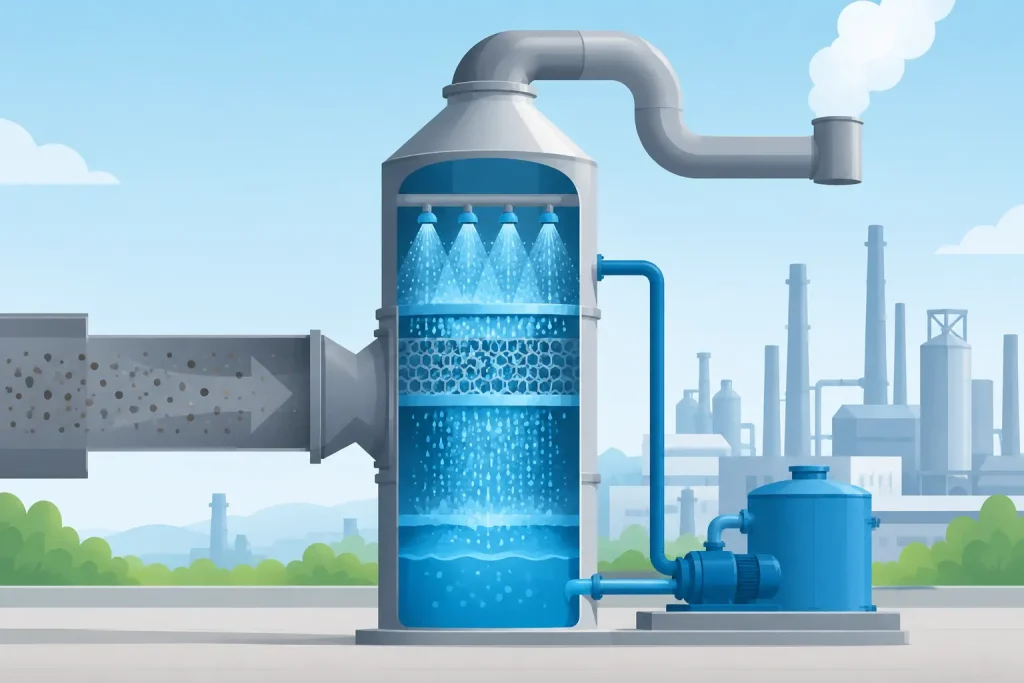
A wet scrubber is an air pollution control device that brings contaminated gas into contact with a liquid, usually water or a chemically treated scrubbing solution. The liquid captures particulate matter, absorbs gases, or neutralizes chemical pollutants before the treated air is discharged through the stack. The collected material is transferred into a liquid stream for recirculation, treatment, or disposal.
Wet scrubbers are widely applied where emissions are sticky, corrosive, combustible, hot, moisture-sensitive, or difficult to collect using dry filtration alone. They can control acid gases, ammonia, odor compounds, mists, fumes, and certain dusts. Their effectiveness, however, depends on correct process characterization and disciplined operation. A scrubber is not a generic “wash system” that can be added to any exhaust line without engineering review.
How a Wet Scrubber Works
Every wet scrubber relies on gas-liquid contact. Contaminated air enters the scrubber body while liquid is introduced through sprays, nozzles, packing irrigation, or a high-energy venturi throat. As the air and liquid interact, pollutants move from the gas stream into liquid droplets or onto wetted surfaces.
For particulate control, droplets collide with particles and carry them into the scrubber liquor. Fine particles require greater relative velocity and contact energy, which is why venturi scrubbers are commonly used for demanding particulate applications. Larger particles and coarse mist may be removed effectively at lower energy in spray towers or cyclone scrubbers.
For gaseous pollutants, capture depends on solubility and chemical reaction. Hydrogen chloride, sulfur dioxide, chlorine, ammonia, and similar compounds may dissolve in water, but water alone is not always sufficient. An alkaline solution can neutralize acidic gases, while an acidic solution may be used for alkaline gases such as ammonia. The right reagent, concentration, pH control, liquid-to-gas ratio, and contact time are all part of the design basis.
After the gas passes through the scrubbing zone, it travels through a mist eliminator. This section removes entrained droplets before discharge. A poorly maintained mist eliminator can increase stack carryover, create visible plume issues, corrode downstream ductwork, and reduce airflow as pressure drop rises.
Common Industrial Wet Scrubber Configurations
The term wet scrubber covers several equipment designs. Selecting the right configuration starts with the contaminant, emission rate, temperature, moisture content, required removal efficiency, and allowable fan energy.
Packed Tower Scrubbers
A packed tower scrubber uses structured or random packing to create a large wetted contact surface. Contaminated gas flows through the tower, often upward against downward-flowing liquid. This countercurrent arrangement provides strong gas absorption performance and is well suited to acid gas neutralization, ammonia control, odor treatment, and chemical process vents.
Packed towers require proper liquid distribution. Uneven irrigation can leave dry channels through the packing, allowing untreated gas to bypass contact surfaces. Packing selection must also consider fouling, chemical compatibility, temperature, and the risk of solids accumulation.
Venturi Scrubbers
A venturi scrubber accelerates gas through a narrow throat while liquid is introduced into the high-velocity zone. The intense turbulence atomizes the liquid into fine droplets and improves capture of fine particulate matter. This makes venturi systems suitable for metallurgical fume, pigment dust, mineral processing emissions, and processes with difficult fine particles.
The trade-off is pressure drop. Higher collection efficiency typically requires more energy, meaning a larger induced-draft fan and higher operating cost. The system must be designed as an integrated package, including fan duty, duct velocity, recirculation pumps, mist elimination, and controls.
Spray Towers and Cyclonic Wet Scrubbers
Spray towers use liquid nozzles to create droplets within an open vessel. They are mechanically straightforward and useful for cooling, pre-cleaning, or removal of highly soluble gases and coarse particulate. Their lower pressure drop can be an advantage, but they are generally less effective for submicron particulate than high-energy venturi designs.
Cyclonic wet scrubbers use centrifugal action to force contaminated gas and liquid into contact. They can handle variable loads and may be effective where a compact footprint is required. As with all configurations, actual performance must be confirmed against the process emission profile rather than assumed from the equipment name.
What a Wet Scrubber Can and Cannot Control
Wet scrubbers are especially valuable when pollutants are soluble, reactive with a scrubbing reagent, or present as mists and particulate that can be captured by droplets. They can also cool hot gas streams and reduce fire or explosion concerns associated with certain combustible dust applications. That does not mean water is appropriate for every dust hazard. Some materials react violently with water, generate flammable gas, or form problematic slurries.
A wet scrubber may not be the best primary control device for dry, free-flowing dust where a pulse-jet dust collector can achieve high collection efficiency with less wastewater management. Similarly, volatile organic compounds with low water solubility may require activated carbon adsorption, thermal oxidation, or another technology rather than a simple water scrubber. In some facilities, a multistage system is the appropriate answer: for example, a cyclone for coarse particulate followed by a packed tower for acid gas absorption.
The engineering decision should be based on representative source data. This includes airflow, temperature, humidity, particulate loading and size distribution, gas concentration, chemical composition, oxygen content, pressure conditions, and operating variability. Field auditing and stack sampling are often necessary where process information is incomplete or emissions have changed since the original installation.
Design Factors That Determine Performance
A reliable wet scrubber is designed around measurable duties, not broad claims of “high efficiency.” The required outlet concentration, permitted mass emission rate, and compliance test method should be defined before equipment sizing begins.
Key design factors include the gas flow rate, liquid-to-gas ratio, residence time, pressure drop, reagent consumption, recirculation rate, nozzle coverage, packing depth, and mist eliminator face velocity. For chemical absorption, pH and oxidation-reduction potential may need continuous monitoring. Automatic chemical dosing can help keep the scrubber within its operating range, but it does not replace routine inspection and verification.
Materials of construction are equally important. Carbon steel, stainless steel, fiberglass-reinforced plastic, polypropylene, PVC, and specialty alloys each have appropriate applications. Selection must account for chemical concentration, temperature, chloride exposure, abrasion, UV conditions, and external structural requirements. A material that is acceptable for dilute ambient-temperature acid may fail quickly under hot, concentrated conditions.
The design must also address wastewater. The captured pollutant does not disappear. It becomes part of the scrubber liquor, blowdown stream, or sludge. Facilities need a defined approach for solids separation, pH adjustment, wastewater treatment, and disposal under applicable local, state, and federal requirements. Ignoring this step shifts an air-emission problem into a water-management problem.
Operation, Maintenance, and Compliance Evidence
Wet scrubber performance can deteriorate quietly. Plugged nozzles, worn pumps, scaling, low reagent strength, damaged packing, fan imbalance, and mist eliminator fouling may all reduce control efficiency while the system appears to be running. A visible fan rotation indicator is not evidence that the pollution control system is meeting its duty.
A practical preventive maintenance program should verify differential pressure, recirculation flow, pump condition, pH or reagent concentration, nozzle spray pattern, mist eliminator cleanliness, fan amperage, and duct integrity. Operators should maintain records of inspections, chemical use, calibration, corrective actions, and abnormal operating events. These records support environmental reporting, permit inspections, and root-cause analysis after an excursion.
Testing and commissioning should establish baseline values for airflow, pressure drop, liquid flow, and outlet performance. Periodic stack sampling can then confirm that actual emissions align with permit limits and design expectations. Where continuous or online performance monitoring is required, instrument selection and alarm limits should reflect meaningful indicators of scrubber health rather than only on-off status.
Specifying a Wet Scrubber for Long-Term Control
The best specification describes the process problem before it describes the equipment. It should identify contaminants, concentrations, flow ranges, temperatures, required emission limits, available utilities, space constraints, corrosion conditions, wastewater strategy, and the preferred level of automation. It should also define acceptance testing, documentation, operator training, spare parts, and after-sales service expectations.
For existing systems, an upgrade assessment may be more cost-effective than a full replacement. A new mist eliminator, improved liquid distribution, variable-frequency drive, upgraded fan, automated dosing package, or revised packing can materially improve performance. But upgrades should follow measurement and engineering review, not trial-and-error modifications.
A wet scrubber earns its value when it is treated as a controlled process, not a passive piece of equipment. Start with accurate emission data, select the contact mechanism that matches the contaminant, and maintain operating evidence that can stand up to compliance review. That approach protects people, production continuity, and the facility’s permission to operate.