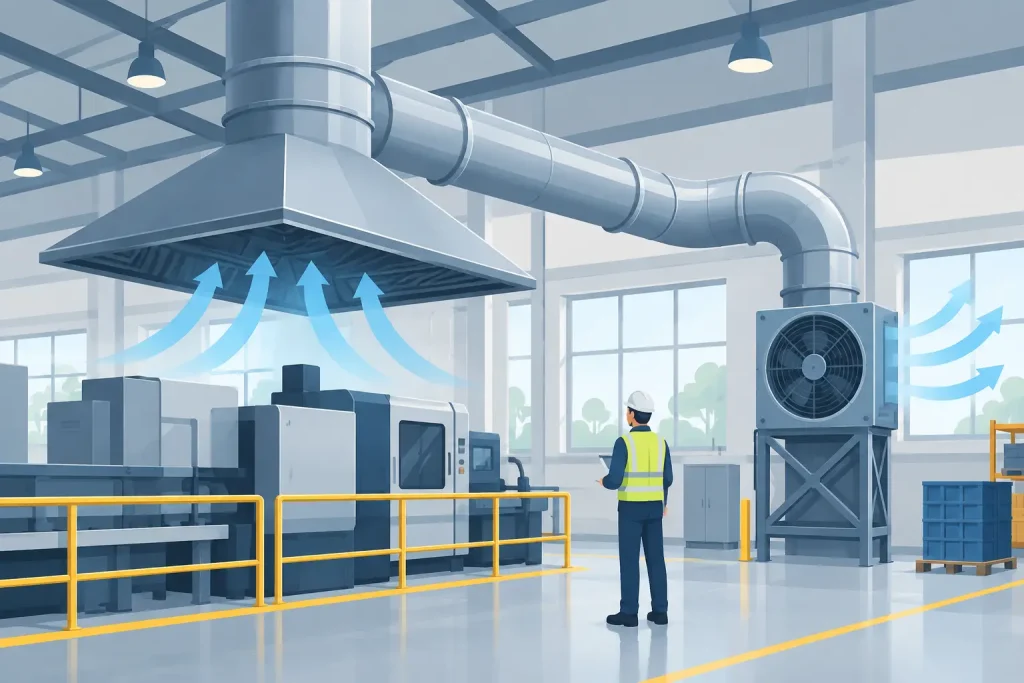
A welding bay may look clear while hazardous fume remains in the worker’s breathing zone. A dust collector may run continuously while poor hood placement allows powder to settle across the production floor. These are not minor ventilation issues. They indicate that the industrial ventilation guide used for design, operation, and maintenance is incomplete.
Effective industrial ventilation is a controlled engineering system, not simply a fan connected to ductwork. It must capture contaminants at the point of generation, transport them at the right velocity, separate or destroy pollutants using suitable equipment, and discharge air in a manner that supports occupational and environmental compliance. The system also needs to remain effective as production volumes, materials, and process conditions change.
Start With the Contaminant and the Process
Ventilation design begins at the process, not with equipment selection. Plant teams should identify what is generated, when it is released, how it behaves in air, and who may be exposed. Grinding, cutting, casting, bag dumping, and feed transfer commonly produce particulate dust. Welding and thermal processes can produce metal fume, smoke, and combustion byproducts. Solvent cleaning, coating, printing, and chemical storage may release volatile organic compounds (VOCs). Machining can create oil mist that is difficult to capture with a general exhaust system.
Particle size, temperature, moisture content, chemical reactivity, and explosibility all affect the engineering approach. Fine, dry dust may suit a pulse-jet dust collector, while sticky or wet particulate can blind filter media and require pre-separation, a wet scrubber, or a different collection arrangement. Corrosive gas streams may require a packed tower scrubber with compatible packing, recirculation chemistry, and materials of construction. VOC control may call for activated carbon filtration, air stripping, or regenerative thermal oxidation, depending on concentration, flow rate, and recovery objectives.
The process survey should also document operating patterns. A hood designed for one open mixing vessel may fail when three vessels are opened at once. Similarly, a system sized for a single shift can lose capture performance after a production expansion. Design airflow must reflect the real operating condition, including foreseeable peak loads.
Capture at the Source Before Contaminants Spread
The most reliable place to control a contaminant is as close as practical to where it is generated. Once dust or fume disperses into the room, substantially more airflow is needed to dilute it, and workers may already have been exposed.
Local exhaust ventilation, often referred to as LEV, uses a hood or enclosure to create capture around the source. The hood geometry matters as much as the fan capacity. A receiving hood for a conveyor transfer point, a slot hood along a plating tank, and a movable extraction arm at a welding station each require different capture strategies. Distance is critical: capture velocity decreases rapidly as the hood is moved away from the emission source.
Enclosure usually provides the strongest control because it limits cross-drafts and contains the contaminant before it enters the work area. However, full enclosure may restrict access, slow material handling, or create maintenance challenges. Partial enclosure combined with properly positioned extraction can be a practical alternative when operators need frequent access to the process.
General dilution ventilation has a role in removing heat and controlling low-level residual contaminants, but it should not be treated as the primary control for high-emission processes. It is a supplement to source capture, not a substitute for it.
Design Airflow, Ductwork, and Fan Duty as One System
A ventilation system succeeds only when its components are engineered as a complete air-moving system. The fan must overcome pressure losses created by hoods, ductwork, dampers, filtration equipment, silencers, and the discharge stack. Selecting a fan only by air volume can result in inadequate suction once filters load or production conditions vary.
Airflow is commonly expressed as volume per unit of time, while duct transport velocity must remain high enough to prevent particulate settling. If velocity is too low, dust accumulates in duct runs, increasing blockage, fire, and housekeeping risks. If velocity is too high, energy use, noise, duct abrasion, and fan wear increase. The right design point depends on the contaminant and duct configuration.
Duct layout should minimize unnecessary elbows, abrupt transitions, dead legs, and long flexible connections. Branch balancing is equally important. Without proper balancing dampers and commissioning measurements, the branch nearest the fan may receive excessive airflow while a distant hood receives too little. Operators will often respond by opening dampers fully or modifying hoods, which can worsen the imbalance.
Make-up air must be considered at the same time. Exhausting large volumes of air without planned replacement air can create negative pressure, difficult door operation, poor combustion performance, uncomfortable drafts, and loss of hood effectiveness. Conditioned make-up air has an operating cost, but it may be necessary to protect process stability and worker comfort.
Match Air Pollution Control Equipment to the Duty
The air cleaning device should be selected based on contaminant characteristics, required outlet performance, maintenance capability, and applicable permit conditions. No single technology is correct for every plant.
A pulse-jet dust collector is often appropriate for dry industrial dust where high filtration efficiency and continuous cleaning are required. The final result depends on filter media selection, air-to-cloth ratio, pulse-cleaning settings, hopper discharge, and maintenance of compressed air quality. A dust collector with damaged bags, leaking valves, or a full hopper cannot deliver its intended performance.
Cyclones and multi-cyclones can serve as pre-cleaners for coarse particles or high dust loading. Their lower pressure drop can be beneficial, but they generally do not provide the fine-particle control of a properly designed fabric filter. Electrostatic precipitators can manage certain fine particulate applications, while packed tower scrubbers are commonly used for soluble gases, acidic mists, and chemical fumes. Scrubbers require disciplined control of liquid flow, pressure drop, pH, chemical dosing, and blowdown.
For VOCs and odors, activated carbon filters may be effective at suitable concentrations, but media breakthrough must be monitored and managed. Regenerative thermal oxidizers are used where VOC destruction efficiency and continuous duty justify the higher capital, fuel, and operational demands. The best option depends on the emission profile and lifecycle cost, not purchase price alone.
Commission, Test, and Document Performance
Installation is not the end of the project. Testing and commissioning establish whether the system performs as designed under representative production conditions. This should include airflow measurement at key hoods and branches, duct velocity checks, static pressure readings, fan performance verification, filter differential pressure assessment, and confirmation of equipment interlocks.
Where an emission source is regulated, stack sampling provides defensible data on discharge performance. Field auditing can identify operational gaps such as damaged flexible ducts, bypassed controls, open access panels, poor hood positioning, or improper waste discharge from scrubber systems. These findings should be converted into corrective actions with clear responsibilities and completion dates.
Facilities operating under Malaysia’s Clean Air Regulations 2014 and DOSH LEV requirements need documentation that supports statutory obligations. For US facilities, the applicable OSHA requirements, EPA permits, state air rules, and local authority conditions should define the compliance pathway. The engineering principle remains the same: records must demonstrate that controls are designed, operated, inspected, and maintained for their intended duty.
Keep Ventilation Performance From Drifting
Ventilation performance changes gradually, which is why many failures are discovered only after complaints, visible emissions, or an inspection. A practical preventive maintenance program tracks differential pressure, fan vibration, motor current, airflow, scrubber chemistry, compressed air condition, hopper discharge, and duct integrity. Trend data is more useful than isolated readings because it reveals deterioration before it becomes an outage.
Online performance monitoring can provide earlier warning of abnormal pressure drop, reduced suction, or fan operating changes. It does not replace physical inspection, but it gives maintenance and EHS teams a clearer basis for intervention. Spare parts readiness is equally important for items such as filter bags, solenoid valves, gaskets, bearings, belts, and instrumentation.
Competent people are part of the control system. Training for responsible personnel, including CePSO and CePBFO competency pathways where applicable, helps facilities connect daily operating decisions with compliance duties. Operators who understand why a hood must remain positioned correctly are far less likely to defeat a control for convenience.
Master Jaya Group approaches industrial ventilation as a full lifecycle responsibility: process assessment, engineered design, in-house fabrication, installation, testing and commissioning, stack sampling, monitoring, and after-sales service. That accountability matters because clean-air performance is proven in daily operation, not on a layout drawing.
The next time a ventilation system is reviewed, begin at the worker and the emission source. Measure what the hood is actually capturing, confirm where the air is going, and act on the data before a small loss of suction becomes a compliance or exposure event.