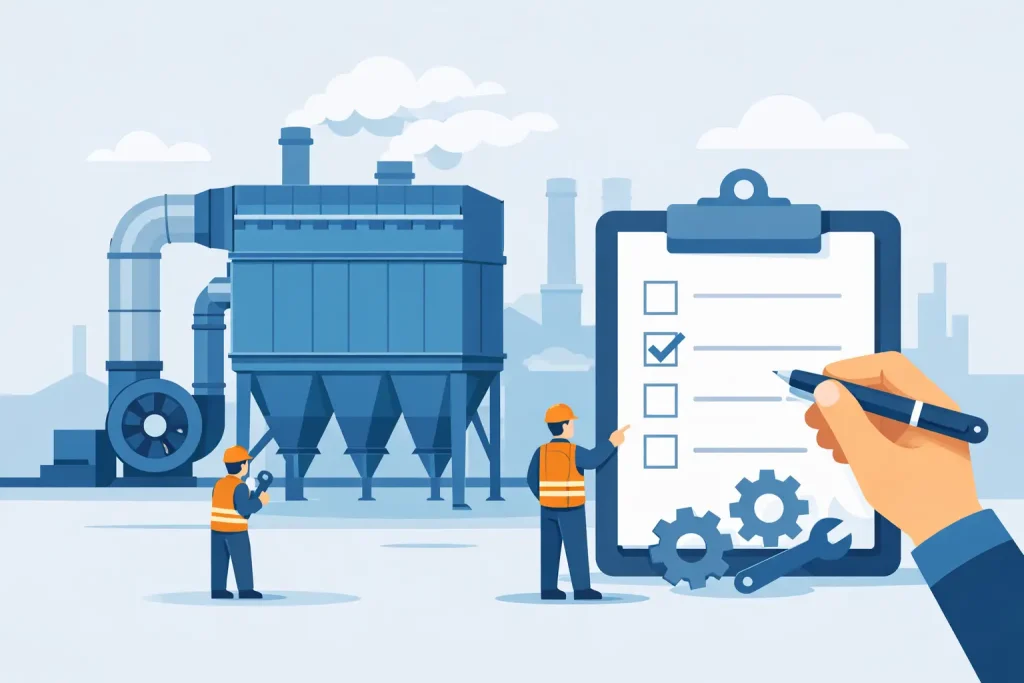
A baghouse can look complete, start without obvious alarms, and still fail its first meaningful operating test. A reversed fan rotation, a leaking access door, insufficient compressed-air pressure, or an unbalanced pickup point can leave dust in the work area and create an avoidable compliance exposure. A disciplined baghouse commissioning checklist for factories turns installation into verified operating performance before the system is handed over to production.
For plant managers, EHS leaders, and maintenance teams, commissioning is not a final box to check after construction. It is the point at which the design basis, installed equipment, process conditions, and compliance obligations must align. The record created during this work also becomes the baseline for troubleshooting, preventive maintenance, stack testing, and future system upgrades.
Why baghouse commissioning requires more than a startup
A pulse-jet baghouse is a connected system, not just a filter housing. It includes capture hoods, ductwork, dampers, fan, motor, discharge equipment, compressed-air supply, filter media, instrumentation, electrical controls, and safety devices. A problem at any point can reduce collection efficiency or upset production.
Commissioning must therefore verify two different outcomes. The first is mechanical and functional readiness: equipment is safely installed, energized, and operating as designed. The second is process performance: the system captures dust at the source, maintains the required airflow, cleans filters effectively, and discharges collected material without creating a secondary dust problem.
The acceptable performance criteria depend on the process, dust characteristics, permit conditions, and applicable safety requirements. A collector serving welding fume behaves differently from one handling fine food powder, casting sand, wood dust, or combustible metal dust. The commissioning plan should reflect that reality rather than relying on generic fan readings alone.
Baghouse commissioning checklist for factories
The checklist should be prepared before field work begins and completed with actual readings, not check marks based on assumptions. The following areas form a practical sequence for testing and commissioning.
1. Confirm the approved design basis and documentation
Start by comparing the installed system with approved drawings, specifications, and the process duty. Confirm the collector model, filter media type, air-to-cloth ratio, fan capacity, motor rating, duct sizes, hopper configuration, rotary valve or screw conveyor capacity, and control panel details.
Review the design airflow at each hood or branch, expected static pressure, target differential pressure range, compressed-air requirement, and emissions requirement. If a process change occurred during construction, such as adding a machine, moving a pickup hood, or changing material feed rates, the original design may no longer represent the actual load.
Collect equipment manuals, electrical single-line diagrams, wiring diagrams, pneumatic diagrams, filter specifications, fan curves, motor data, calibration certificates, and spare-parts recommendations. These documents should be available to the operating and maintenance team before handover, not retained only by the installation contractor.
2. Inspect mechanical installation and access
Perform a walkdown from the capture point through the discharge point. Check that hoods are positioned correctly relative to the dust source and that they are not obstructed by guards, product flow, or operator work practices. A well-sized collector cannot compensate for a hood that is too far from the emission point.
Inspect duct supports, flange connections, expansion joints, cleanout doors, access doors, hopper transitions, and weather protection. Confirm that gaskets are seated, doors close tightly, and no visible openings allow false air into the system. Excessive air leakage can reduce effective pickup velocity and make fan performance appear inconsistent.
Verify that filter bags or cartridges are correctly installed, cages are undamaged, and tube-sheet openings are properly sealed. Inspect hopper slopes and discharge devices for bridging risks, especially where dust is moist, fibrous, sticky, or prone to compaction. Confirm safe access for filter replacement, hopper cleaning, fan inspection, and instrument servicing.
3. Verify electrical, controls, and interlocks
Before operating the fan, confirm incoming voltage, phase sequence, grounding, overload settings, motor rotation, emergency-stop function, and panel labeling. A rotation check is essential. A centrifugal fan running backward may still move air, but it will not deliver the intended pressure or airflow.
Test every required interlock in the intended sequence. The dust collector fan may need to start before process equipment, while a rotary airlock or screw conveyor may need to run before dust enters the hopper. Where applicable, process equipment should stop or alarm if the baghouse fan fails, the discharge device stops, or differential pressure reaches a defined high limit.
Confirm that the differential-pressure transmitter, pressure switches, temperature sensors, level switches, and airflow indicators are installed at the correct locations and provide plausible readings. Instrumentation that has not been calibrated or function-tested cannot provide defensible evidence of operating condition.
4. Test compressed-air cleaning performance
Pulse cleaning is often treated as a simple utility connection. It is not. Measure compressed-air pressure at the collector while pulsing is active, not only at the plant header. Pressure loss through undersized lines, restricted filters, water traps, or simultaneous demand from other equipment can weaken the cleaning pulse.
Check air quality as well as pressure. Wet or oil-contaminated air can damage filter media, clog pulse valves, and cause poor dust release. Confirm operation of the air receiver, regulator, solenoid valves, diaphragm valves, blowpipes, and timer or differential-pressure controller.
Run cleaning cycles and listen for consistent pulse intensity across each row. Uneven pulsing may indicate blocked blowpipe holes, leaking diaphragm valves, incorrect valve wiring, or a controller sequencing error. Set cleaning parameters conservatively during initial operation, then adjust using stable differential-pressure trends rather than excessive continuous pulsing.
5. Balance airflow at hoods and branches
Airflow verification is the most direct test of whether the baghouse is protecting workers and containing dust. Measure airflow, velocity, and static pressure at representative hoods, branch ducts, and main ducts. Compare field readings with design values and identify branches that are starved or drawing excessive air.
Damper positions should be recorded after balancing. Leaving dampers unmarked means the system can drift out of balance after routine maintenance. Observe each pickup point under normal production conditions, including material charging, transfer, grinding, cutting, mixing, or discharge. Visual dust escape at the source is a process-performance issue even if the fan motor current appears normal.
Where multiple machines do not operate at the same time, confirm the intended operating scenario. A system designed for diversity may not maintain capture if all branches are opened simultaneously. This is a capacity decision that should be documented for operations, not discovered after production expands.
6. Confirm dust discharge and safety safeguards
Verify that dust is removed continuously from hoppers and transferred to the intended bin, drum, conveyor, or disposal point without leakage. A full hopper can raise differential pressure, damage filters, interfere with pulse cleaning, and create dust release during maintenance.
For combustible dust applications, the commissioning scope must include the safeguards identified by the dust hazard analysis and the applicable code requirements. Depending on the material and collector location, this may include explosion venting, isolation devices, suppression systems, grounding and bonding, spark detection, or abort gates. These systems require dedicated functional verification by qualified personnel. They should never be treated as optional accessories.
Also verify safe lockout/tagout points, guarding on rotating equipment, access platforms, ladder condition, warning labels, and confined-space considerations around hoppers and bins. Compliance performance and worker safety are inseparable during collector startup.
7. Establish performance records and acceptance criteria
Conduct a controlled operating run long enough to observe stable differential pressure, fan load, airflow, cleaning behavior, hopper discharge, and visible capture performance. Record the process rate and material being handled during the test. Readings taken while the process is idle have limited value.
The final commissioning file should include:
- Approved drawings and equipment data sheets
- Mechanical, electrical, and safety inspection records
- Airflow, static-pressure, and differential-pressure readings
- Compressed-air pressure and cleaning-controller settings
- Fan speed, motor current, and damper positions
- Interlock and alarm test results
- Operator training records, punch-list closure, and handover acceptance
If stack sampling, visible-emissions evaluation, or permit reporting is required, plan this work around representative production conditions. An emissions result is only defensible when the collector, process load, and test method are properly documented.
Turning commissioning data into operational control
The most useful commissioning package does not sit in a project folder. It gives the maintenance team normal operating values to compare against during routine inspections. A gradual rise in differential pressure, a lower-than-baseline hood velocity, or a change in fan amperage can signal a developing problem before dust becomes visible on the shop floor.
Set inspection frequencies for filter condition, compressed-air quality, hopper discharge, belt or coupling condition, and instrument verification. Keep critical spares available, particularly filter media, diaphragm valves, solenoids, gaskets, and discharge-device components. For facilities with ongoing compliance exposure, online performance monitoring can provide earlier warning of abnormal trends and support a more traceable operating record.
Master Jaya Group approaches testing and commissioning as part of a complete clean-air responsibility, supported by field auditing, stack sampling, servicing, spare-parts readiness, and performance monitoring. The practical value is not merely a collector that starts. It is a documented system that continues to capture dust, protect personnel, and support the factory’s compliance obligations after production pressure returns.