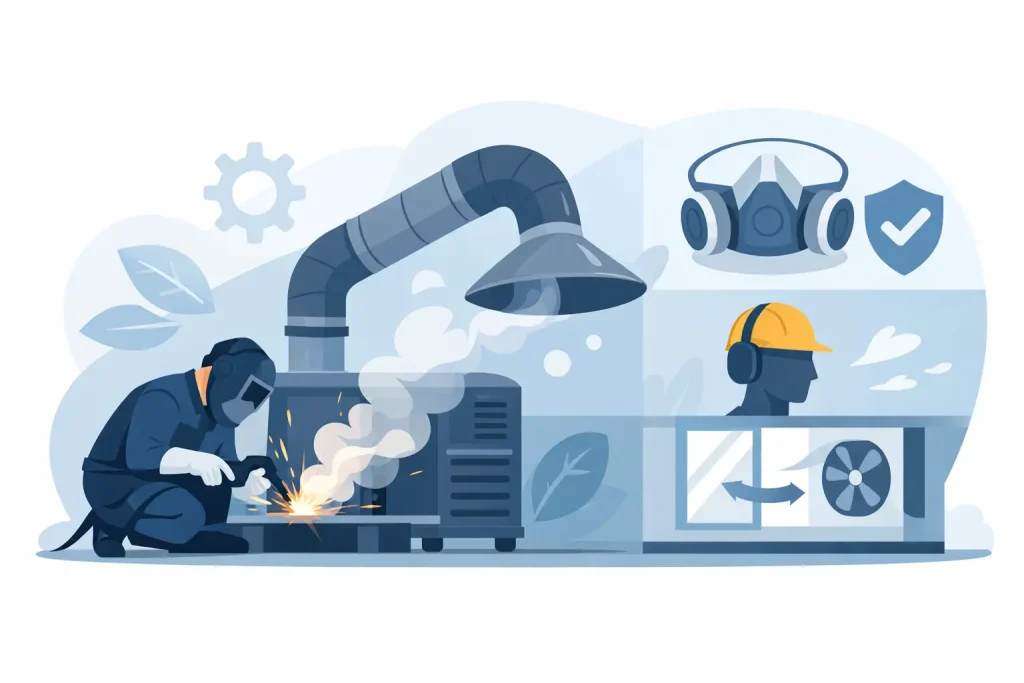
A welding bay can look acceptable at a glance while still carrying a serious exposure problem. If operators are seeing haze, smelling metal fumes, or reporting throat irritation by mid-shift, the issue is already beyond comfort – it is a control failure. Knowing how to reduce welding fume exposure starts with treating fumes as an engineered air-quality risk, not a housekeeping issue.
Welding fume is a complex mixture of very fine particles and gases generated when metal is heated above its boiling point and condenses in air. Depending on the base metal, filler, coating, and process, the plume may contain iron oxide, manganese, hexavalent chromium, nickel compounds, ozone, nitrogen oxides, and other contaminants of occupational concern. For plant managers, EHS leaders, and operations teams, that creates two linked responsibilities: protect worker breathing zones and maintain a documented, defensible control strategy.
Why welding fume control fails in real facilities
Most exposure problems do not come from a complete lack of equipment. They come from partial controls that were never designed around the process. A wall fan, an open roller door, or a general exhaust system may make the area feel less stuffy, but none of those measures guarantees effective capture at the point where fume is generated.
The difficulty is that welding fume rises with thermal energy, then disperses quickly depending on cross-drafts, part geometry, welder position, and workpiece size. A control method that performs adequately on a bench station can fail on large fabricated assemblies, inside tanks, or at rotating production cells. This is why a one-size-fits-all answer rarely holds. The correct solution depends on process type, work positioning, throughput, and compliance targets.
How to reduce welding fume exposure at the source
The most reliable approach is source capture. In practical terms, this means pulling contaminants away before they enter the welder’s breathing zone and before they spread into the wider workspace. Local exhaust ventilation, or LEV, remains the primary engineering control for this reason.
A properly designed LEV system is more than a hood attached to a duct. Capture hood type, placement, duct sizing, static pressure, airflow balance, filtration efficiency, and fan selection all affect whether the plume is actually controlled. If the hood is too far from the arc, suction performance drops sharply. If cross-drafts from cooling fans or open doors interfere with the plume, the fume escapes before it is captured. If duct losses were underestimated, the system may look operational while delivering insufficient face velocity.
For fixed welding stations, extraction arms or close-capture hoods can work well when operators can position them consistently. For larger assemblies or repetitive fabrication, downdraft tables, backdraft booths, or enclosed extraction booths may provide more stable control. High-production lines may require a centralized dust and fume collection system with properly engineered branch ducts and balancing dampers so performance remains consistent across multiple stations.
Filtration also matters. Welding fume contains fine particulates, so collector design should match the particle loading and characteristics of the process. Cartridge collectors are commonly used for welding applications, but the selection should be based on dust properties, duty cycle, cleaning method, and maintenance access. A system that captures well but is difficult to service often degrades over time because filters are not changed, pulse cleaning is not optimized, or pressure drop is ignored.
Process choices can lower fume generation
Not every reduction comes from ventilation hardware. Process changes can reduce the amount of fume generated in the first place. This does not mean production should accept lower weld quality or slower output. It means reviewing whether the current method is creating unnecessary exposure.
Welding parameters influence fume generation. Higher current, longer arc length, and certain consumables can increase fume production. Shielding gas selection may also affect both weld performance and fume characteristics. In some operations, changing from one welding process to another can materially reduce emissions, although trade-offs need to be evaluated carefully. A lower-fume process may affect deposition rate, penetration, operator familiarity, or capital cost.
Surface condition is another overlooked factor. Oils, paints, primers, galvanizing, and other coatings can produce additional hazardous decomposition products when heated. Cleaning the workpiece before welding will not eliminate all fume, but it can significantly reduce contaminant complexity and help the extraction system perform more effectively.
Automation can also reduce direct worker exposure where production volume justifies it. Robotic welding cells do not remove the need for extraction, but they can limit the amount of time operators spend in the immediate fume zone. The capital case depends on throughput, product consistency, and floor layout, so this is usually most attractive in repetitive manufacturing rather than mixed, low-volume fabrication.
General ventilation is support, not the main control
Facilities often overestimate what roof ventilators or wall-mounted fans can do. General ventilation helps dilute residual contaminants and improve room conditions, but it should not be treated as the primary measure for hazardous welding fume. Dilution alone is too variable, especially when production rates change or when welding is performed in enclosed or partially obstructed spaces.
That said, ambient air movement still needs to be managed. Poor make-up air design can disrupt local capture by pushing the fume plume away from the hood or back across the welder’s face. Good system design balances extraction with controlled replacement air so that the workspace remains under manageable airflow conditions rather than becoming turbulent.
This is where engineered assessment becomes critical. Airflow should be reviewed as a whole system, including hood positioning, fan duty, filter loading, and surrounding process influences. In many plants, improving a welding fume control system is not about adding more horsepower. It is about correcting the airflow path.
PPE matters, but it should not carry the whole burden
Respiratory protection has an important place in welding operations, particularly during maintenance work, temporary jobs, high-exposure tasks, or periods when engineering controls are being serviced. However, respirators should not be the first or only answer when the process itself can be controlled.
Fit, filter selection, worker training, and actual wear time all affect respirator effectiveness. Even a suitable respirator can fail in practice if workers remove it to communicate, if it interferes with welding visibility, or if facial hair affects the seal. For this reason, PPE should sit within a broader exposure control program that prioritizes elimination, substitution where feasible, and engineering controls before administrative controls and personal protection.
Welding helmets with powered air-purifying support may improve usability in some environments, but suitability depends on the contaminants present and the task conditions. The right selection should follow a formal hazard assessment rather than a purchasing preference.
Monitoring, verification, and compliance documentation
If you cannot verify performance, you cannot confidently claim control. Plants that take welding fume seriously establish a monitoring routine that goes beyond visual inspection. Airflow measurements, hood static pressure checks, filter differential pressure trends, and periodic industrial hygiene sampling provide the evidence needed to confirm that controls are working.
For regulated facilities, documentation is just as important as equipment. Inspection records, testing and commissioning reports, corrective maintenance logs, and exposure assessments create a defensible compliance position. Where local requirements apply, the ventilation system should also be aligned with occupational exposure expectations and any relevant LEV inspection obligations.
This is where many industrial operators benefit from working with a one-stop solution provider that can support auditing, system design, fabrication, installation, testing and commissioning, and longer-term servicing. A compliance-led partner can also help connect worker exposure control with wider plant obligations such as emissions management, field auditing, stack sampling, and ongoing performance monitoring.
Training and operator behavior still influence exposure
Even a well-designed system can be undermined by daily practice. Operators need to understand why hood placement matters, why blocked slots reduce suction, and why temporary fixes such as taping open access panels can upset system balance. Supervisors and maintenance teams should also know what early warning signs look like – visible fugitive fume, dust accumulation near capture points, rising pressure drop, or recurring complaints from welders.
Training should be practical and task-based. The goal is not to turn every welder into a ventilation engineer. It is to make control performance visible in the course of normal work. Facilities with stronger environmental and occupational governance often extend this mindset through formal competency development and compliance training so responsibilities are not left vague.
A better question than how to reduce welding fume exposure
The better question is whether your current control strategy would stand up to measurement, inspection, and a real production day. If the answer is uncertain, the next step is not another portable fan. It is a technical review of capture effectiveness, airflow design, filtration performance, and compliance evidence.
In welding environments, clean air is not achieved by intention alone. It is achieved by engineered control, verified performance, and consistent follow-through over the life of the system.