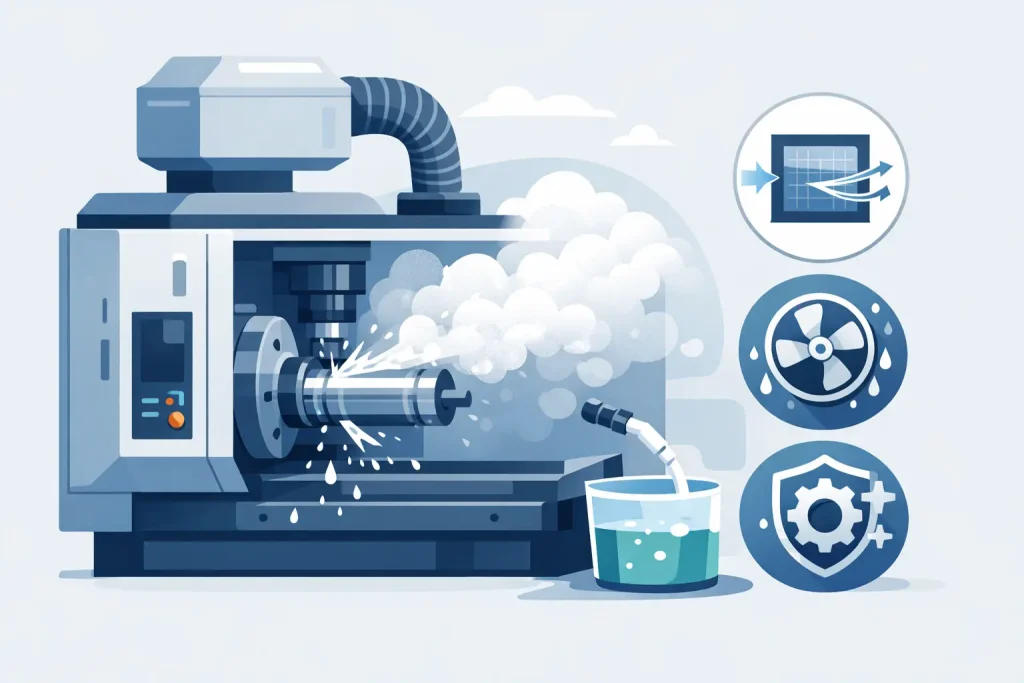
A CNC enclosure that looks clean from the outside can still release a visible haze the moment the door opens. That haze is usually a sign that oil mist is escaping capture, settling on equipment, exposing operators, and creating a preventable compliance risk. For plants asking how to reduce oil mist in machining, the answer is rarely a single collector. It starts with how the mist is generated, how it moves, and whether the extraction system is engineered for the actual process.
Oil mist in machining is not just a housekeeping issue. In metalworking operations, it affects indoor air quality, machine reliability, slip hazards, filter loading, and worker exposure. In facilities with multiple machining centers, the problem can spread beyond one line and become a plant-wide ventilation issue. A practical solution has to balance capture efficiency, production uptime, maintenance access, and local regulatory expectations.
Why oil mist forms in machining
Oil mist is created when metalworking fluid is atomized into fine droplets during high-speed cutting, grinding, drilling, or turning. The generation rate depends on spindle speed, tool geometry, fluid pressure, enclosure design, and the type of coolant or neat oil used. Higher speed and pressure generally produce finer droplets, which stay airborne longer and are harder to capture than heavier particles.
The particle size matters because it determines what kind of control strategy will work. Larger droplets may settle inside the machine or be captured with good hood design. Fine submicron mist behaves more like smoke. It follows airflow patterns, leaks through enclosure gaps, and requires properly selected multi-stage filtration. This is where many systems underperform. They are sized for visible splash and carryover, not for the fine aerosol fraction that drives exposure complaints.
Heat also changes the picture. As the cutting zone temperature rises, some fluids generate vapor that later condenses into very fine mist. In those cases, a basic filter-only approach may not be enough. The system has to account for both droplet capture and post-cooling condensation behavior.
How to reduce oil mist in machining at the source
The most effective reduction strategy begins before air reaches a collector. If mist generation is excessive, even a well-built extraction system will be forced to compensate for a process problem.
Start with coolant application. Over-delivery is common. If fluid is applied at higher pressure or volume than the operation requires, atomization increases without improving machining performance. Reviewing nozzle placement, pressure setting, and flow rate often reduces mist immediately. The best setting is not the highest setting. It is the one that provides cooling and lubrication while minimizing airborne carryover.
Fluid selection also matters. Different oil formulations and water-miscible fluids produce different aerosol behavior under the same machining conditions. Viscosity, additive package, and thermal stability all affect mist formation. Changing fluid should never be done casually because it can affect tool life and part quality, but it is worth reviewing when a plant has chronic mist issues despite adequate ventilation.
Machine enclosure integrity is another source-control issue that gets overlooked. Damaged door seals, cable penetrations, open roof sections, and poor panel fit let mist escape before extraction can establish directional airflow. In many plants, the fastest improvement comes from restoring enclosure containment and verifying that doors remain closed during the cycle whenever operationally possible.
Local exhaust ventilation is where performance is won or lost
When companies ask how to reduce oil mist in machining, they often focus on the collector model. In practice, local exhaust ventilation design usually determines whether the project succeeds.
A machining center needs capture at the point where mist accumulates and escapes, not just a fan connected somewhere on the enclosure. Hood takeoff location, duct velocity, machine static pressure, and enclosure air balance all matter. If extraction pulls from the wrong point, dead zones remain inside the machine and mist rolls out when doors open. If suction is too aggressive, it can disturb the process or pull excessive liquid into the duct. If it is too weak, the haze simply bypasses the system.
For centralized systems serving multiple machines, balancing becomes even more critical. Different machines run different cycles and generate different mist loads. Without proper duct design and dampers, one machine may be over-ventilated while another receives almost no effective capture. This is why field auditing and airflow verification are not optional. They are part of system engineering.
LEV performance should also be reviewed against workplace exposure control expectations. In many facilities, oil mist extraction is treated as a comfort upgrade until an audit or employee complaint exposes the gap. A compliance-led approach is stronger. It ties hood design, airflow measurements, and maintenance records to a defensible exposure-control program. Where applicable, plants should align extraction review with DOSH-LEV requirements and formal testing.
Filtration technology must match the mist profile
Once mist is captured, filtration has to remove it reliably without creating a maintenance burden that operators work around. There is no universal filter arrangement for all machining processes.
Mechanical pre-separation is useful where large droplets are present. Baffle stages or inertial pre-filters reduce liquid loading before air reaches fine filters. This improves filter life and helps oil drain back instead of saturating the media. For applications dominated by fine aerosol, high-efficiency coalescing stages are often required. These filters collect small droplets, merge them into larger drops, and allow drainage. In operations with smoke-like particulate or very fine condensate, a final high-efficiency stage may be necessary to achieve acceptable discharge quality.
The trade-off is pressure drop. Higher efficiency generally means greater resistance, which affects fan sizing and energy use. If the fan is not selected for the full loaded condition, airflow falls as filters load and the system slowly stops doing its job. Plants often notice the problem only after residue appears on machine surfaces again. The right design accounts for clean and dirty pressure conditions, drainage behavior, and realistic service intervals.
Collected liquid handling matters too. If drainage is poor, filters re-entrain oil and performance becomes erratic. A well-engineered system allows safe recovery or disposal of drained liquid and keeps service points accessible. If maintenance is awkward, it will be delayed.
Maintenance discipline is part of mist control
Even a correctly designed system will underperform without routine servicing. Oil mist collectors fail gradually, not dramatically. Filters blind, drains clog, ductwork accumulates residue, and differential pressure trends get ignored.
A disciplined maintenance plan should include filter inspection, pressure drop checks, drain verification, fan condition review, and duct cleanliness assessment. For enclosed machine tools, door seals and extraction points should be inspected at the same time. This is where after-sales service and spare parts readiness become operational advantages, not just procurement details.
Plants with recurring issues should consider performance monitoring rather than relying only on complaint-based maintenance. Trend data on airflow, pressure, and service intervals can show whether a system is drifting out of specification long before visible haze returns. In larger facilities, an online monitoring layer can support maintenance planning and provide useful documentation for EHS review.
Compliance, documentation, and verification
Oil mist control should be documented like any other engineered emission-control measure. That means recording design basis, airflow targets, filter stages, maintenance intervals, and verification results. If the system discharges externally or ties into a regulated air stream, stack sampling and commissioning records may also be relevant depending on the installation.
This is where many plants benefit from working with a one-stop solution provider rather than a standalone equipment supplier. A compliance-ready project does not end at equipment delivery. It includes design review, fabrication quality, installation, testing and commissioning, field auditing, and support for ongoing operating performance. Master Jaya Group follows this lifecycle approach because clean-air results depend on the whole system, not just the collector casing.
For facilities with internal competency requirements, training also supports better outcomes. Maintenance and EHS teams need to understand what acceptable extraction performance looks like, what warning signs matter, and when a mist problem is actually a process issue. That operational knowledge reduces the chance of repeating the same failure mode after every filter change.
How to reduce oil mist in machining without hurting production
The best projects do not force a choice between air quality and throughput. They reduce oil mist while protecting cycle time, machine access, and serviceability. That usually means taking measurements first, then designing around the process rather than applying a catalog unit by rule of thumb.
A plant with a few enclosed CNC machines may solve the problem with machine-mounted collectors and enclosure improvements. A high-volume facility with many machining centers may need a centralized system with engineered balancing, staged filtration, and ongoing performance monitoring. Grinding lines, high-pressure coolant systems, and neat-oil applications each bring their own design requirements.
If oil mist is visible in the aisle, coating electrical cabinets, or triggering repeated complaints, the issue is already affecting plant performance. The right response is not to oversize a fan and hope for the best. It is to identify the generation mechanism, verify capture at the source, select filtration for the actual aerosol profile, and maintain the system like the critical control it is.
Cleaner air in a machining plant is usually the result of disciplined engineering, not guesswork – and that is what keeps both compliance and production on stable ground.