A plating line that runs well on throughput can still fail on air quality. Acid mist is one of the most common reasons. When hydrochloric acid, sulfuric acid, nitric acid, or mixed-process vapors are released from tanks, pickling lines, or wet chemical operations, the problem is not only visible corrosion or worker discomfort. It is also a compliance, maintenance, and uptime issue. That is where an industrial scrubber for acid mist control becomes a critical engineered system rather than a simple accessory.
For plants managing corrosive emissions, the wrong approach usually shows up fast. Ductwork degrades early, fans lose performance, nearby structures corrode, and capture at the tank edge becomes inconsistent. In parallel, exposure concerns increase around process areas, and documentation for environmental and occupational compliance becomes harder to defend. Acid mist control needs to be treated as a full system – source capture, duct transport, gas-liquid contact, mist elimination, discharge verification, and long-term monitoring.
Why an industrial scrubber for acid mist control matters
Acid mist is different from general dust or dry particulate. It behaves as a corrosive aerosol, often with fine droplet sizes that can remain suspended and migrate beyond the source area if capture is weak. In metal finishing, surface treatment, battery-related processes, and chemical manufacturing, those emissions can affect worker exposure, product quality, structural assets, and stack compliance at the same time.
A properly engineered industrial scrubber for acid mist control is designed to neutralize and remove these contaminants before discharge. In most applications, the system does not work alone. It depends on correctly sized hoods or tank enclosures, suitable face velocity, corrosion-resistant ducting, and fan selection that can maintain stable suction under real operating conditions. Plants that buy only the vessel and ignore the rest of the airflow system often end up with a technically installed scrubber that still underperforms in the field.
This is why project scope matters. Design calculations, fabrication material, pump sizing, recirculation chemistry, and testing and commissioning all influence whether the final result is merely operational or truly compliance-ready.
How the system works in real plant conditions
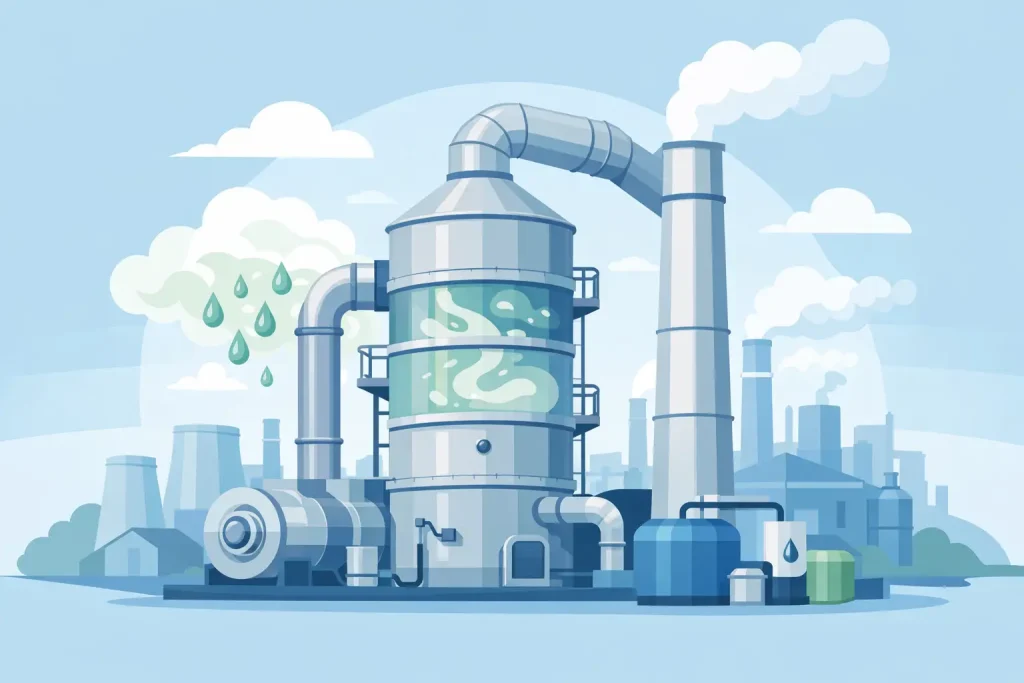
The most common configuration for acid mist service is a packed tower scrubber. Contaminated air enters the tower and passes through packing media while scrubbing liquid is distributed from above. This creates a large contact area between the gas stream and liquid phase, allowing the acid mist to be captured and neutralized. A mist eliminator at the outlet then helps prevent liquid carryover before discharge to atmosphere.
In straightforward applications, this principle is effective and reliable. The challenge is that real plant conditions are rarely straightforward. Airflow may fluctuate with production load. Process tanks may release bursts of higher concentration during charging, dipping, or agitation. Operators may partially close dampers to reduce perceived noise or save energy, which changes system balance. If the scrubbing loop is not designed for these realities, efficiency can drop even when the equipment appears to be running normally.
For that reason, scrubber design should account for gas temperature, contaminant profile, expected acid loading, pressure drop, recirculation rate, chemical dosing strategy, and maintenance access. Material selection is equally important. FRP, PP, PVC, and rubber-lined steel may each be suitable depending on chemistry, temperature, and mechanical duty. There is no universal answer. A system that handles sulfuric acid mist well may not be the right solution for a mixed-acid process with elevated temperature and chloride content.
Source capture is where performance begins
Many acid mist problems are misdiagnosed as scrubber problems when the root cause is poor capture. If the hood design does not pull contaminants into the duct at the point of release, the downstream scrubber cannot remove what never reaches it.
Open-surface tanks, pickling baths, etching lines, and chemical process vessels need capture designs that match plant operation. Push-pull ventilation may work in one line, while a slotted hood, side draft hood, lip exhaust, or partial enclosure may perform better in another. Tank geometry, operator access, hoist movement, and thermal currents all affect capture efficiency.
This is also where operational trade-offs appear. Full enclosure improves containment, but it may interfere with loading, inspection, or maintenance. Higher air volume can improve capture, but it raises fan power demand and may increase water consumption or pressure drop in the scrubber. The best design is usually not the most aggressive on paper. It is the one that maintains controllable, repeatable performance during daily production.
Compliance is not just about stack discharge
Plants usually approach acid mist control because they need cleaner discharge, but stack emissions are only one part of the risk profile. Worker exposure, corrosive settling on equipment, and internal air quality complaints often drive the real urgency. In regulated environments, that means emissions control should be aligned with broader environmental and occupational obligations, including requirements tied to local clean air regulations and workplace exposure control programs.
A compliant system therefore needs more than installed hardware. It requires field auditing, airflow verification, instrumentation checks, and testing and commissioning records that can stand up to internal review and regulator scrutiny. In many facilities, stack sampling becomes essential to verify actual removal performance rather than assumed design performance.
This is where a one-stop project model has practical value. When the same engineering partner handles audit findings, system design, in-house fabrication, installation, testing and commissioning, and after-sales support, accountability is clearer. The plant is not left reconciling conflicting explanations from separate equipment vendors, ducting contractors, and service teams.
Common design mistakes that reduce acid mist removal
The most frequent issue is undersized airflow. Plants sometimes reduce fan duty to save operating cost, but once transport velocity or hood capture drops below the required range, acid mist escapes into the work area and deposits in the duct. Over time, that can create corrosion, liquid accumulation, and unstable performance.
Another common mistake is poor liquid distribution inside the tower. If spray coverage is uneven, sections of packing become underutilized, and gas bypass reduces contact efficiency. The same applies when recirculation chemistry is not maintained. A scrubber that is mechanically sound can still lose efficiency if pH control, dosing, bleed-off, and make-up water management are neglected.
Mist eliminator selection is also often overlooked. Fine droplets that are not properly separated can carry over to the stack, creating visible plume issues or corrosion at the discharge point. In high-load services, demister access for cleaning is not optional. It should be part of the maintenance design from the start.
What to ask before selecting an industrial scrubber for acid mist control
A practical evaluation starts with process data, not catalog data. Decision-makers should ask what acids are present, at what concentration, at what temperature, and during which process steps emissions peak. They should also review whether the goal is control of visible mist, corrosive vapor, occupational exposure, environmental discharge, or all of the above.
From there, the right questions become more specific. Is the source best handled by local exhaust only, or is partial enclosure needed? What material of construction will hold up over the expected service life? How will pH and recirculation quality be controlled? What inspection ports, drain points, and access platforms are included for safe maintenance? Will the supplier provide stack sampling support, field auditing, and documentation for compliance files after commissioning?
Plants with multiple process lines should also think beyond day-one installation. Expansion plans, spare parts readiness, and online performance monitoring can materially reduce long-term risk. A system that performs well at startup but lacks service support often becomes a maintenance liability within a few years.
Long-term performance depends on service discipline
Acid mist systems do not usually fail all at once. They drift. Pressure drop changes gradually, pump strainers foul, nozzles scale, duct leakage develops, and fan performance shifts as components age. Because these changes are incremental, production teams may adapt to them without realizing compliance margin is shrinking.
That is why lifecycle support matters as much as initial design. Regular servicing, periodic inspection, airflow checks, and performance trending help identify when the system is no longer operating at its original intent. Where plants need stronger visibility, IoT-enabled monitoring can support faster response to abnormal pressure, pH, flow, or fan conditions.
For regulated facilities, internal competency is part of that discipline as well. EHS and operations teams need enough technical understanding to recognize warning signs, document corrective action, and engage confidently during audits or official review. Equipment alone does not create defensible compliance. Competence, records, and follow-through do.
Master Jaya Group approaches these projects as a full-scope clean-air responsibility – from auditing and engineered design to fabrication, installation, stack sampling, testing and commissioning, and after-sales support.
When acid mist control is specified correctly, the result is not just a cleaner exhaust stream. It is a more stable process area, less corrosion-related disruption, stronger compliance evidence, and a plant team that can operate with fewer unknowns. That is usually the real value of getting the system right.