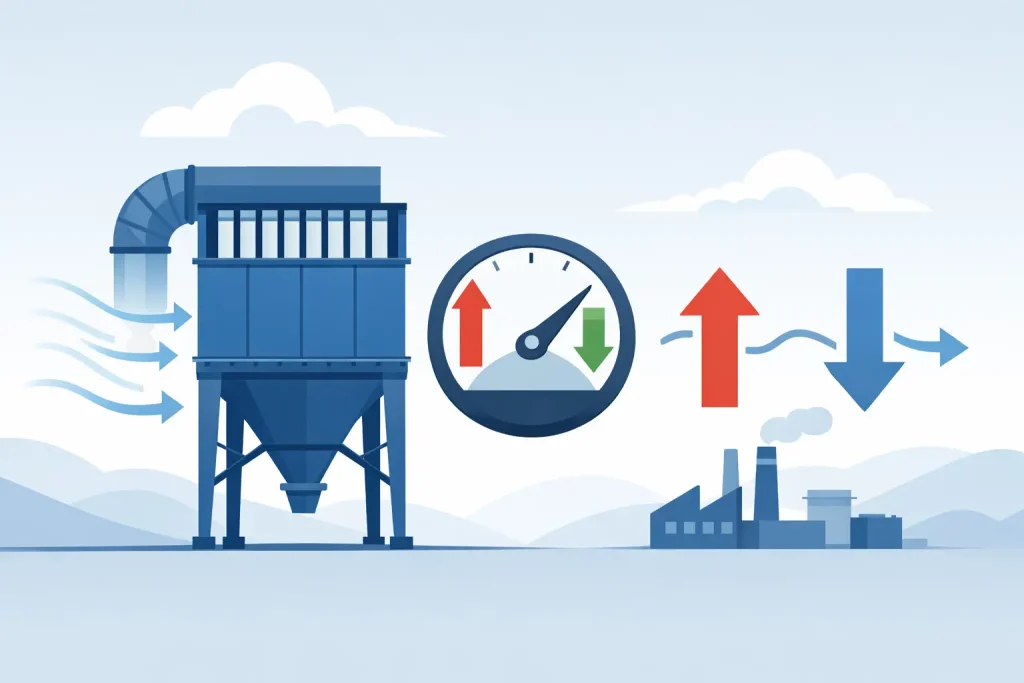
A baghouse rarely starts with a dramatic failure. More often, the first sign is a fan working harder, suction falling off at pickup points, and operators noticing that dust is no longer moving the way it did during commissioning. If you are evaluating how to reduce baghouse pressure drop, the right approach is not to simply change filters faster or increase cleaning pressure. Pressure drop is a system condition, and it usually reflects a combination of dust characteristics, airflow balance, cleaning performance, and mechanical condition.
For plant managers, EHS teams, and maintenance leaders, this matters for more than energy use. High differential pressure can reduce capture efficiency, affect process stability, and create compliance risk when extraction performance drops below the level needed for the application. In facilities handling metal fines, food powders, minerals, or thermal process dust, a disciplined response is the difference between a stable emissions control system and repeated service calls.
What baghouse pressure drop is really telling you
Pressure drop across a baghouse is the resistance to airflow created by the filter media, the dust cake, and any restrictions in the system. Some resistance is necessary. A baghouse with zero dust cake would not typically be operating at its best filtration efficiency, because the dust cake itself often contributes to fine-particle capture.
The problem starts when resistance rises beyond the design operating window. At that point, the induced draft fan may not maintain required airflow, hoods may lose capture velocity, and compressed air consumption for pulse cleaning may increase. In severe cases, bags blind prematurely, ductwork accumulates dust because transport velocity drops, and process areas see visible fugitive emissions.
That is why the answer to how to reduce baghouse pressure drop is not to chase the lowest possible number. The target is stable differential pressure within the design range established during system design, testing and commissioning, and baseline performance checks.
Start with the operating baseline before making changes
Before replacing components, confirm what has actually changed. Compare current differential pressure, airflow, fan amperage, hopper evacuation frequency, compressed air pressure, and process loading against known normal conditions. If the baghouse performed well for months and then drifted, the cause is often operational or maintenance-related. If it has struggled since startup, the issue may be design-based, such as incorrect air-to-cloth ratio, poor inlet distribution, or the wrong filter media selection.
This step is often missed. Plants sometimes respond to high pressure drop by increasing pulse frequency, which can temporarily lower differential pressure while damaging bags, increasing compressed air cost, and reducing dust cake stability. Good troubleshooting starts with data, not guesswork.
Check whether the filters are blinded, overloaded, or simply wrong for the duty
A common cause of elevated pressure drop is filter blinding. This happens when dust embeds into the media and cannot be removed effectively by pulse cleaning. Fine hygroscopic dust, oily particulate, sticky process residue, and condensation events are frequent contributors.
If the bags are blinded, cleaning harder will not solve the underlying problem. The plant needs to determine why the dust is adhering. Sometimes the issue is process temperature dropping below dew point, allowing moisture to condense on the bags. In other cases, the media finish is unsuitable for the dust type, or the collector is seeing a loading rate above its design basis.
Media selection matters more than many facilities expect. Polyester may be acceptable in one service and fail quickly in another where temperature, moisture, or particle abrasiveness differ. Surface-treated media, membrane-laminated media, or specialty fibers may reduce pressure drop over time by improving dust release. The trade-off is cost. However, in many industrial applications, the lifecycle cost of premature bag failure, downtime, and poor extraction is much higher than the initial media upgrade.
Review pulse-jet cleaning performance
If a pulse-jet baghouse cannot clean effectively, differential pressure will climb even when the bags themselves are still serviceable. Start by checking compressed air pressure at the manifold, not just at the compressor. Leaks, undersized lines, wet air, and pressure fluctuations can all reduce pulse energy.
Then inspect diaphragms, solenoid valves, blowpipes, and pulse sequencing. A failed diaphragm valve may leave an entire row under-cleaned. Misaligned blowpipes can reduce cleaning efficiency and create uneven bag wear. If pulse intervals have been adjusted without reference to actual operating conditions, over-cleaning or under-cleaning may both occur.
The goal is controlled cleaning based on the collector load profile. A differential-pressure-based cleaning strategy is often more stable than a fixed timer-only approach, especially where process loading changes by shift or batch. With online monitoring, maintenance teams can identify pressure trends early and correct valve or air supply issues before they affect plant performance.
Look beyond the collector to the airflow system
Anyone asking how to reduce baghouse pressure drop should also inspect the ducting, fan, dampers, and hood balance. The collector may not be the only source of resistance. Dust buildup in duct runs, partially closed dampers, worn fan impellers, or poor inlet distribution can all alter system behavior and present as a baghouse problem.
A fan operating away from its design point can make pressure drop appear worse than it is from an extraction standpoint. Likewise, if process modifications have added new pickup points or increased dust loading without rebalancing the system, the baghouse may now be handling a duty it was never sized to support.
This is where field auditing is valuable. Static pressure readings across key system points, fan performance checks, and airflow verification at hoods provide a clearer picture than differential pressure alone. In compliance-sensitive plants, this level of assessment supports defensible maintenance decisions and helps restore suction performance to the intended design standard.
Hopper discharge and dust handling are often overlooked
A baghouse cannot maintain stable pressure drop if collected dust is not leaving the system properly. Hopper bridging, rotary valve failure, screw conveyor stoppage, and dust backup into the hopper section can interfere with gas flow and re-entrain particulate.
When hoppers are not evacuating as designed, the collector may see abnormal turbulence and higher resistance. This is especially common with light, cohesive, or irregularly shaped dusts. Heater failures, poor hopper geometry, or unsuitable discharge equipment can turn a filtration issue into a solids handling issue.
Maintenance teams should verify that level sensors, discharge devices, and hopper internals are functioning correctly. In some cases, process-specific modifications are required rather than repeated bag replacement.
Eliminate false air, leaks, and temperature-related problems
Not every pressure drop issue comes from too much dust cake. Air leaks can disturb the collector in several ways. In-leakage upstream may cool the gas stream and trigger condensation. Housing leaks can affect pressure readings and airflow distribution. Access doors, tube sheet seals, and inspection panels should all be checked during troubleshooting.
Temperature control is equally important. If the gas stream enters the collector too hot, media can degrade and lose permeability. If it enters too cool, moisture may condense and cause sticky buildup. Processes with variable temperature profiles need a design and operating strategy that keeps conditions within the filter media limits at all times, not only during steady-state operation.
When the root cause is design, not maintenance
Some collectors run with persistently high pressure drop because the original design margin was too narrow. An aggressive air-to-cloth ratio, insufficient filtration area, poor plenum design, and short bag spacing can all limit clean operation. In these cases, maintenance can only manage symptoms.
A proper engineering review may show that the most effective correction is a retrofit: adding filtration area, changing cage and bag configuration, improving inlet baffling, upgrading controls, or replacing the cleaning system components. That decision should be based on measured performance, process duty, and compliance requirements, not just the cost of spare parts.
For plants operating under strict emissions and workplace exposure obligations, a baghouse should be treated as a compliance-critical asset. The right fix is the one that restores stable extraction, supports emissions performance, and reduces repeated intervention.
How to reduce baghouse pressure drop without creating new problems
The fastest fix is not always the best one. Increasing pulse pressure may reduce differential pressure today and shorten bag life next month. Installing a more open media may lower resistance but weaken fine dust capture if it is not properly selected. Raising fan speed may recover airflow but increase wear and energy use.
A better path is structured troubleshooting: verify the baseline, inspect media condition, confirm cleaning performance, review system airflow, check hopper discharge, and assess whether operating conditions still match the original design basis. In many facilities, the answer is a combination of maintenance correction and targeted upgrade rather than one single intervention.
When baghouse performance is tied to emissions compliance, worker exposure control, and production uptime, pressure drop should never be treated as an isolated number. It is a useful early warning signal. If you respond to it methodically, it can help you prevent larger failures, protect process continuity, and keep the air control system operating the way it was intended to operate.