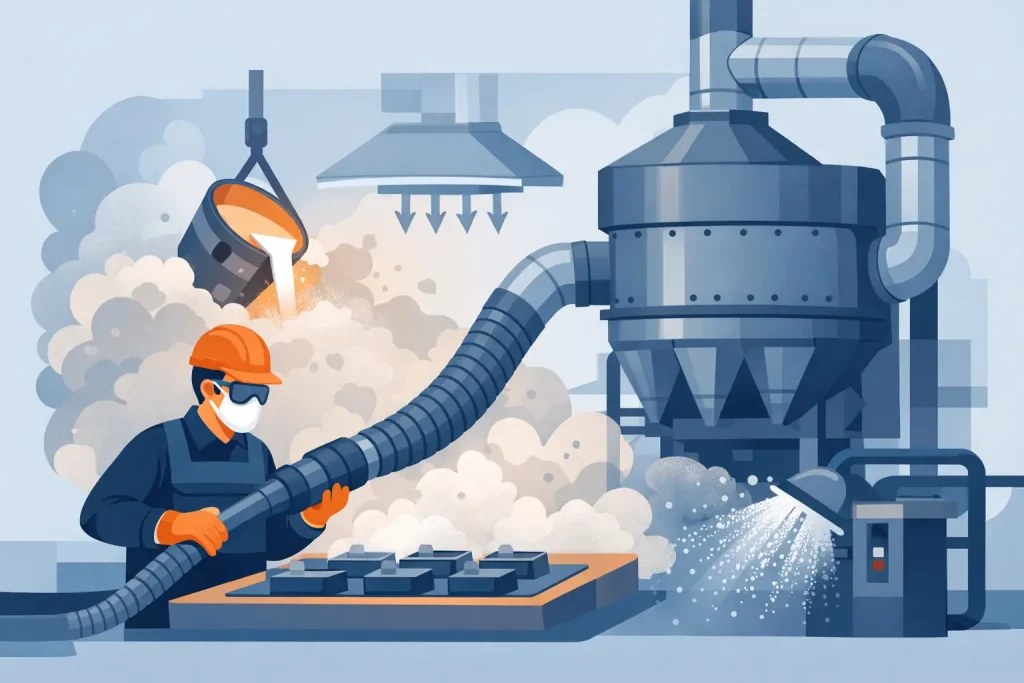
A foundry rarely has one dust problem. It has many, happening at different temperatures, particle sizes, and production stages. That is why the best dust control methods for foundries are never based on a single piece of equipment. They depend on where dust is generated, how it behaves in the airstream, and what the plant must document to satisfy environmental and occupational requirements.
Foundry dust is also not limited to visible spillage around shakeout or molding lines. Silica-bearing dust, fine particulate from sand handling, furnace-related fumes, shot blast emissions, and material transfer losses can all create compliance risk and maintenance burden at the same time. If the system is designed only for housekeeping, it will usually fail on capture efficiency, duct balance, and long-term operating stability.
What makes foundry dust control difficult
Foundries combine high dust loading, intermittent process peaks, abrasive particulate, and elevated temperatures. A baghouse that performs well on one line may struggle when connected to another source with hotter gas, coarser particles, or moisture carryover. The engineering challenge is not just filtration efficiency. It is matching the right capture and cleaning method to each source while keeping static pressure, airflow, and maintenance within a workable range.
Process variation matters. Green sand systems, no-bake operations, fettling, grinding, reclaim systems, and shot blasting do not produce the same dust characteristics. Some points need high-velocity pickup to prevent settling in ducts. Others need gentler enclosure and directional airflow so the process is not disrupted. In practice, the best-performing foundry systems are source-specific, not generic.
Best dust control methods for foundries start at the source
The first priority is source capture. If dust is allowed to disperse into the building, the plant ends up paying twice – once in poor air quality and again in housekeeping, re-entrainment, and filter loading. Local exhaust ventilation, or LEV, should be engineered around the actual dust release point rather than placed nearby as an afterthought.
For molding, shakeout, sand transfer, and screening operations, partial or full enclosures with properly sized hoods are usually the most effective approach. Capture velocity must be high enough to pull particulate into the hood before cross-drafts and operator movement scatter it. Hood placement matters as much as fan capacity. Even a powerful collector underperforms when the hood geometry ignores how the operator loads, pours, or clears material.
For grinding and fettling stations, close-capture backdraft or side-draft hoods are often preferred, sometimes combined with booth-style containment. These applications generate aggressive particulate with a strong tendency to escape into breathing zones. The design goal is to maintain effective suction at the point of generation without interfering with access, visibility, or ergonomics.
For conveyor transfer points and reclaimed sand systems, enclosure integrity is critical. Air leaks through poorly sealed covers can reduce transport velocity inside the duct network and make balancing difficult. In many plants, basic mechanical issues such as open access panels, worn skirt seals, or damaged duct branches reduce performance more than the collector itself.
Choosing the right collector technology
In most foundry applications, pulse-jet bag filters remain the primary dust collection method because they can manage high airflow, continuous duty, and fine particulate capture. They are especially suitable when the system must maintain performance during sustained production hours and when compliance targets demand low outlet emissions.
That said, collector selection should not be reduced to baghouse equals solved. Filter media choice, air-to-cloth ratio, hopper design, explosion protection strategy where applicable, and cleaning cycle logic all affect whether the system stays reliable. Abrasive dust can shorten bag life if inlet conditions are not controlled. Hot gas can damage media if cooling or dilution is ignored. Fine sticky dust can blind filters if moisture enters the system.
Cyclones and multi-cyclones often have a supporting role rather than serving as the final control stage. They are useful as pre-cleaners where dust loading is heavy and particle size is relatively coarse. By removing larger particulate before it reaches the main collector, they can reduce wear, improve bag life, and stabilize pressure drop. They are rarely the only answer when fine particulate emission limits must be met.
Wet scrubbers can be appropriate in selected foundry processes, particularly where hot gases, sticky particulate, or combined fume and dust streams make dry filtration less suitable. The trade-off is that wet systems introduce liquid handling, corrosion considerations, sludge management, and a different maintenance profile. They should be selected because the process requires them, not because they appear simpler on paper.
Ducting, airflow balance, and system stability
A good collector attached to a poor duct network will not deliver dependable control. Duct sizing must keep transport velocity high enough to prevent dust settling while avoiding unnecessary pressure loss. Branch balancing is equally important. In foundries, it is common to see one production area overdrafted while another receives too little suction because the network was extended over time without recalculation.
System stability also depends on fan selection and control philosophy. If the process has wide variation in operating loads, a fixed-volume approach may waste energy or underperform at peak conditions. Variable frequency drives, damper control, and staged operation can improve performance, but only when they are integrated into the original design logic. Ad hoc adjustments by maintenance teams often solve one symptom while creating another.
Hopper discharge and dust handling downstream of the collector deserve the same attention. Dust accumulation, bridging, or air leakage at rotary valves can compromise the entire system. A dust control project is not complete at the filter housing. It ends at reliable collection, discharge, containment, and disposal.
The role of housekeeping and process discipline
Housekeeping is not the main dust control method, but it is still part of the control strategy. Settled dust becomes airborne again under forklift traffic, compressed air cleaning, and general movement across the shop. If housekeeping is used as the primary method, the plant is already behind.
The better approach is to reduce escape at source, then support it with vacuum-based cleaning methods and disciplined maintenance practices. Compressed air blowdown for floor cleaning should be tightly controlled or eliminated where possible because it re-entrains fine particulate into worker breathing zones and throughout the building.
Process discipline matters too. Open chute transitions, overfilled hoppers, delayed maintenance on enclosure seals, and unplanned changes in throughput all affect emissions. Foundries that achieve stable compliance usually treat dust control as an operating system, not a one-time capital purchase.
Monitoring, testing, and compliance assurance
The most reliable dust control systems are verified, not assumed. Airflow measurements, hood face checks, static pressure trending, and differential pressure monitoring help confirm whether the system is still operating as designed. Without these checks, plants may not detect declining performance until visible dust, worker complaints, or failed testing makes the problem obvious.
Testing and commissioning are essential after installation or major modification. Field auditing can identify leakage, poor capture, duct imbalance, and fan issues before they become chronic. Stack sampling provides defensible emissions data, while LEV assessment supports worker exposure control and maintenance planning. For facilities operating under regulatory frameworks such as Malaysia’s Clean Air Regulations 2014 and DOSH-LEV requirements, these records are not optional paperwork. They are part of how the plant demonstrates control.
Online monitoring adds another layer of operational visibility. A pressure trend or alarm condition can show filter loading issues, cleaning faults, or airflow drift long before the problem becomes visible on the floor. For plant managers and EHS leaders, this is where a lifecycle service model has real value. The system can be reviewed, serviced, and corrected before it affects production or compliance status.
What the best dust control methods for foundries look like in practice
The best results usually come from a combined approach: source capture hoods or enclosures, correctly engineered ducting, pulse-jet dust collectors sized to the process, and verification through testing and monitoring. In some plants, pre-cleaning with a cyclone makes sense. In others, a wet scrubbing stage is the better fit. There is no single best technology across all foundries because dust characteristics and operating conditions vary too much.
What is consistent is the need for accountability from design through commissioning and after-sales support. Plants do not benefit from standalone equipment that shifts integration risk back to the user. They benefit from a one-stop solution provider that can design the system, fabricate and install it, complete testing and commissioning, carry out field auditing and stack sampling, and support long-term servicing with spare parts and performance monitoring. That is the standard Master Jaya Group applies when engineering clean-air solutions for industrial facilities.
If your foundry is still relying on general ventilation, manual cleanup, or an aging collector that no longer matches production demand, the next step is not simply replacing hardware. It is identifying where dust is generated, where capture is being lost, and what evidence will prove sustained compliance after the upgrade.