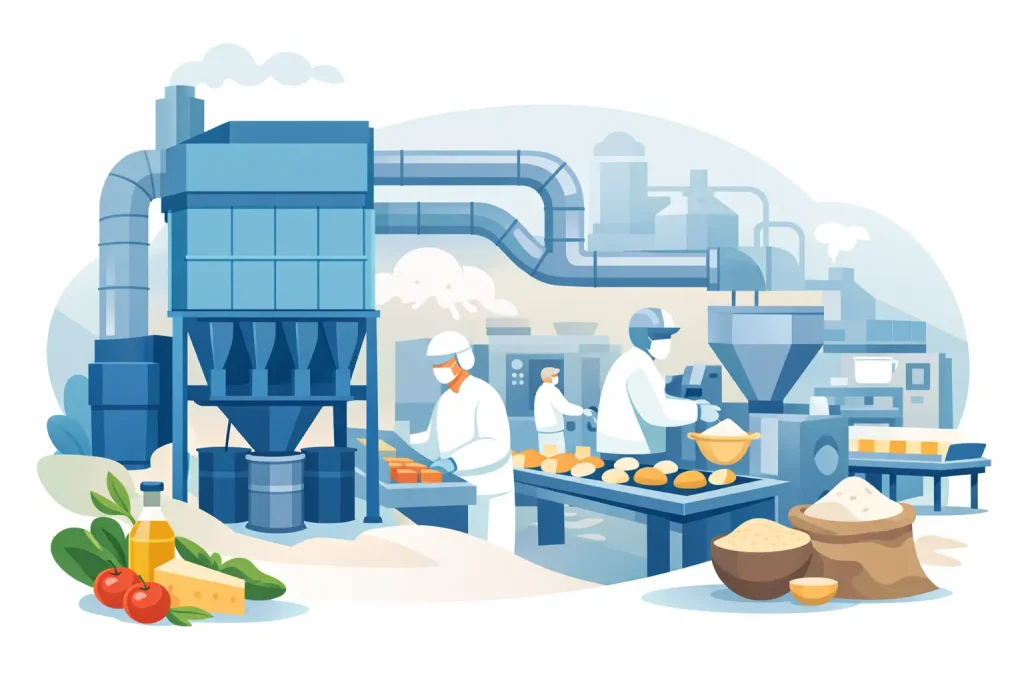
A sugar transfer line that leaves a visible haze near the bag dump station is not a housekeeping issue. In a food plant, it is a product-loss issue, a worker-exposure issue, and in many cases a combustible dust risk. That is why selecting the right industrial dust collector for food processing cannot be treated as a generic utility purchase. The system has to match the material, the process, the sanitation requirements, and the compliance burden carried by the facility.
Food dust behaves differently from the heavier particulate loads seen in foundries or mineral plants. Flour, starch, seasoning powders, milk powder, sugar, cocoa, and feed ingredients can be fine, sticky, hygroscopic, abrasive, or explosible depending on composition and moisture content. Some dusts bridge in hoppers. Others blind filters quickly. Some create cross-contamination concerns between production campaigns. A collector that looks adequate on a datasheet can still underperform once it is exposed to washdown routines, variable batch rates, and the daily reality of food manufacturing.
What an industrial dust collector for food processing must solve
In food processing, dust collection has to achieve more than capture efficiency. It has to protect indoor air quality at points where operators load, convey, mix, sift, grind, discharge, and pack product. It also has to reduce fugitive dust that settles on structures, cable trays, and equipment surfaces. If the dust is combustible, the design basis must address explosion risk and isolation strategy. If the product is allergenic or sensitive to foreign matter, the design must support containment and cleanability.
That is why system selection is usually driven by several objectives at once – process control, employee protection, sanitation, and regulatory defensibility. A plant manager may focus on uptime. An EHS leader may focus on exposure and documentation. A maintenance manager may care most about filter change frequency, differential pressure stability, and spare parts readiness. All of them are correct, because a dust collector becomes a long-term operating asset, not just a box connected to ductwork.
The collector type depends on the process, not just airflow
Pulse-jet bag filters are often the preferred choice for dry food dust applications because they can handle continuous duty and relatively high dust loading. When properly engineered, they provide strong filtration performance with manageable maintenance intervals. They are commonly used for central systems serving mixers, bins, transfer points, and packaging lines.
Even so, not every food application should default to a standard pulse-jet arrangement. Fine sticky powders may require specific filter media, lower air-to-cloth ratios, hopper flow aids, or discharge designs that prevent buildup. Hygroscopic materials may demand temperature and humidity control in the airstream. In some processes, a cyclone or multi-cyclone can be used as a pre-separator to reduce the burden on final filtration and extend filter life.
Source capture also matters. A well-sized collector will still fail if the hood design, branch velocity, and duct balance are wrong. In food plants, capture points are often constrained by access, sanitation, and frequent equipment changeovers. That is why practical design work must start at the emission source and work back through duct routing, fan selection, filtration, discharge, and safe access for servicing.
Hygiene and cleanability change the design standard
A dust collector in a food facility cannot be evaluated the same way as one in a cement or steel operation. Construction details matter. Surface finish, material selection, dead-leg minimization, access door integrity, and cleanout provisions all affect whether the system becomes a contamination risk.
If the plant uses wet cleaning or washdown in adjacent areas, the collector location and enclosure rating must be assessed carefully. In some installations, placing the collector outside the process area is the better option from both hygiene and risk-control standpoints. In others, indoor placement may be necessary, but that raises the importance of access control, housekeeping discipline, and maintenance planning.
Cross-contamination is another issue that gets overlooked during procurement. A collector serving multiple product streams may look efficient from a capital standpoint, yet it can complicate allergen management and changeover validation. Sometimes separate localized systems are the better engineering decision, even when first cost is higher.
Combustible dust cannot be an afterthought
Many food powders can deflagrate under the right conditions. Flour, sugar, starch, grain dust, spice dust, and feed ingredients all require serious hazard review. The right industrial dust collector for food processing must therefore be assessed not only for filtration duty but also for explosion protection, venting, suppression, and isolation, depending on the hazard profile and facility layout.
This is where generic equipment supply becomes a problem. A plant does not just need a collector body and fan. It needs a design package aligned to the dust characteristics, process conditions, and applicable codes and standards. That may include dust hazard assessment inputs, explosion isolation devices, spark control considerations, grounding and bonding, and safe discharge arrangements.
There is no universal answer because risk varies by product and process. A collector for dry sugar conveying may require a different protection strategy than one serving a seasoning room with mixed particle sizes and intermittent loading. The right decision comes from engineering assessment, not assumption.
Compliance is tied to documentation, not just equipment performance
Food manufacturers increasingly need defensible records around emissions control, worker exposure, and system performance. A collector that appears to run well is not enough if there is no traceable basis for design, no testing and commissioning record, and no plan for ongoing verification.
A compliance-led project should cover field auditing, process review, equipment sizing, and performance expectations before fabrication begins. After installation, testing and commissioning should verify airflow, static pressure, suction performance at key pickup points, filter cleaning operation, and overall mechanical integrity. Where required, stack sampling and supporting documentation should be incorporated into the project scope rather than handled as an afterthought.
This lifecycle approach matters because noncompliance is often caused by drift, not immediate failure. Filters age. Duct leakage develops. Dampers are adjusted in the field. Production rates change. Without periodic auditing and monitoring, a system that once performed well can slowly fall outside acceptable conditions.
What to look for in a food-grade dust collection partner
The strongest suppliers in this category do more than fabricate equipment. They take responsibility for clean-air outcomes from design through commissioning and after-sales support. For food processors, that means the partner should be able to evaluate process risk, recommend the appropriate collector configuration, and support the system with servicing, spare parts, and performance review over time.
This is also where engineering depth shows up in practical ways. Can the provider specify suitable filter media for sticky or fine powders? Can it integrate cyclone pre-separation where loading demands it? Can it account for explosion protection, sanitation constraints, and regulatory deliverables within one accountable scope? Can it support field auditing and stack sampling rather than leaving the plant to coordinate multiple subcontractors?
A one-stop solution provider generally reduces project risk because there is less fragmentation between design assumptions and site execution. For facilities under regulatory pressure or internal ESG scrutiny, that single-point accountability is often more valuable than the lowest initial bid.
Signs your current system is undersized or poorly matched
In food plants, underperformance rarely announces itself with one dramatic failure. More often, it appears as recurring symptoms: dust escaping at bag dump stations, frequent filter blinding, unstable differential pressure, dust deposits on overhead structures, or operators opening access points because pickup seems weak. Product loss can also be a signal, especially where reclaimed material is no longer usable because of contamination concerns.
Another warning sign is excessive maintenance intervention. If the team is constantly replacing filters, clearing hopper buildup, or adjusting duct branches to restore suction, the system may be fundamentally mismatched to the process. The same is true when production has expanded over time but the original collector has not been re-evaluated.
In these cases, the right next step is usually not immediate replacement. A structured field audit can determine whether the issue is hood design, air volume, fan performance, filter media selection, cleaning cycle settings, discharge problems, or a broader design limitation. Sometimes an upgrade is enough. Sometimes a new collector is the more defensible long-term solution.
A properly engineered industrial dust collector for food processing should give the plant stable capture performance, manageable maintenance, and documentation that stands up to inspection and internal review. That is the standard serious food manufacturers should expect. When dust control is designed as part of compliance, hygiene, and uptime strategy, it stops being a recurring operational problem and becomes a controlled part of the process.