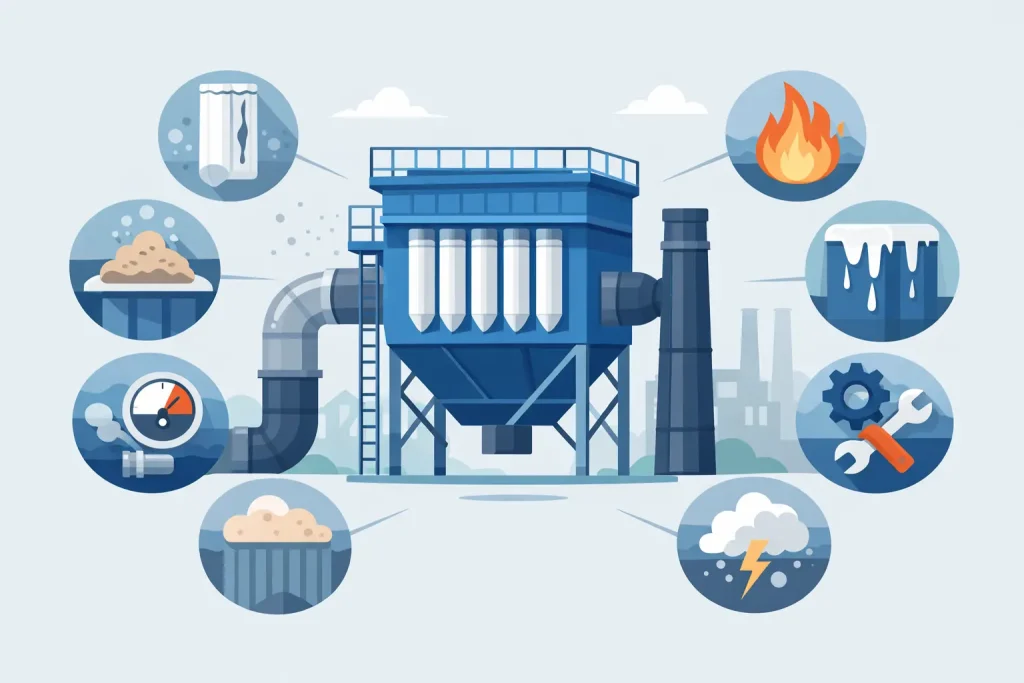
A baghouse rarely fails all at once. More often, the warning signs show up earlier – rising differential pressure, visible emissions at the stack, shortened filter bag life, unstable fan performance, or repeated cleaning-system alarms. When operators investigate only the symptom and not the underlying condition, the same breakdown returns. That is why understanding the common causes of baghouse filter failure matters for both uptime and compliance.
For plants handling process dust, fumes, or fine particulate, baghouse performance sits at the intersection of production reliability, worker exposure control, and environmental obligations. A failed filter element is not just a maintenance issue. It can disrupt throughput, increase housekeeping burden, trigger permit concerns, and weaken the defensibility of stack sampling or inspection results. In regulated environments, root cause analysis needs to be technical, documented, and tied to operating conditions.
Why baghouse failures are rarely caused by one issue
In most facilities, filter failure is cumulative. A bag may tear because of abrasion, but abrasion itself may have been caused by excessive air-to-cloth ratio, poor hopper discharge, or a cleaning system set too aggressively. A blinded bag may appear to be a dust characteristic problem, yet the true cause may be condensation from low inlet temperature or poor startup control.
This is why baghouse troubleshooting should not stop at replacing bags. The collector housing, pulse-jet cleaning system, duct velocity, hopper evacuation, process upset history, and operating temperature profile all need to be reviewed together. Plants that treat the baghouse as a complete engineered system generally see longer filter life and more stable emissions performance.
1. Incorrect filter media selection
One of the most common causes of baghouse filter failure is using media that does not match the actual gas stream. Temperature, dust loading, particle size, moisture content, chemical composition, and abrasiveness all affect media suitability. A bag selected only on initial cost can fail quickly if the process exposes it to acids, hydrocarbons, elevated temperatures, or sticky particulate.
For example, a media that performs well in dry mineral dust service may degrade rapidly in an application with intermittent condensation or corrosive components. Likewise, fine particulate in food, feed, metalworking, or thermal-process applications may require specific finishes or membrane characteristics to maintain release during cleaning. If the media is wrong, no amount of maintenance discipline will fully correct the mismatch.
The practical answer is to validate media selection against real operating data, not nameplate assumptions. That includes upset conditions, startup and shutdown temperature swings, and any process changes introduced after the original system design.
2. Excessive temperature or condensation events
Baghouses operate within a defined temperature window. If inlet temperature exceeds the media limit, the fabric can shrink, harden, embrittle, or fail at the seams. At the other end of the range, if gas temperature falls below the dew point, moisture can condense onto the bags and dust cake. That often leads to blinding, mudding, corrosion, and difficult cleaning.
This failure mode is especially common where thermal oil systems, combustion sources, or variable-load processes create unstable gas temperatures. A collector may appear properly designed at steady state, yet still experience repeated failure during cold starts, bypass conditions, or unplanned process interruptions. In these cases, temperature excursions are not random. They are operationally predictable and should be controlled as part of the baghouse strategy.
Signs include hard caked bags, uneven pressure drop, corrosion inside the housing, and shortened life concentrated around certain compartments. Reviewing temperature trends alongside maintenance history usually reveals the pattern.
3. Improper air-to-cloth ratio and airflow imbalance
When gas volume exceeds design conditions, the baghouse is forced to work harder than its filtration area allows. High air-to-cloth ratio drives dust deeper into the media, increases differential pressure, and makes pulse cleaning less effective. Over time, bags blind prematurely or suffer mechanical stress from constant overloading.
Airflow imbalance creates a similar problem even when the total system volume looks acceptable on paper. Poor duct design, leaking dampers, fan changes, or uneven inlet distribution can overload selected rows or compartments while others remain lightly loaded. The result is localized wear and inconsistent bag life that can be mistaken for random defects.
This is where field auditing becomes valuable. Measuring actual static pressure, airflow, and compartment behavior under production conditions often identifies deviations that are not visible during a routine visual inspection. A baghouse should be assessed as part of the full extraction system, not as a standalone vessel.
4. Cleaning system faults or wrong pulse settings
A pulse-jet collector depends on stable compressed air quality, proper pulse pressure, correct interval timing, and healthy valves, diaphragms, solenoids, and blowpipes. If the cleaning system underperforms, dust remains embedded in the media and differential pressure rises. If it overcleans, the bags experience unnecessary flexing, seam stress, and abrasive wear.
Both extremes shorten filter life. Facilities sometimes increase pulse frequency to respond to high pressure drop without checking whether the root issue is sticky dust, inadequate hopper discharge, or low compressed air pressure. That can create a cycle where cleaning becomes more aggressive while bag condition continues to decline.
A disciplined inspection should verify pulse pressure, sequence integrity, valve response, and compressed air dryness. Oil or moisture carryover in the pulse line can contaminate the media and worsen release characteristics. In many plants, cleaning-system reliability is treated as a utility issue when it should be treated as a primary baghouse performance variable.
5. Abrasion from dust characteristics and mechanical contact
Not all dust behaves the same way. Coarse, angular, or high-velocity particulate can erode filter bags, cages, and inlet areas quickly. Abrasion is often concentrated near the bag bottom, at the snap band, or wherever bags rub against cages or adjacent components. Once the fabric thins, pinholes and tears follow.
Mechanical contact is a frequent but underdiagnosed cause. Damaged cages, rough welds, misalignment, or improper bag installation can create continuous rubbing points. The bags may appear to fail early, but the actual cause is structural. Inlet baffles and flow correction devices also matter. If incoming particulate strikes a narrow section of the bag field at high speed, those bags will fail far sooner than the rest.
Wear patterns tell a useful story. Uniform failure suggests a system-level issue. Localized scuffing or holes usually points to hardware condition, airflow distribution, or installation quality.
6. Poor hopper evacuation and dust re-entrainment
A baghouse can only separate dust effectively if collected material leaves the system consistently. When hoppers bridge, plug, or discharge slowly, dust accumulates and can be re-entrained back into the gas stream. This increases loading on the bags, interferes with cleaning, and contributes to abrasion and pressure-drop instability.
Operators sometimes assume the filter section is the problem when the real issue sits below it. Rotary valves, screw conveyors, level controls, and hopper heaters all influence whether dust exits as intended. Fine, hygroscopic, or cohesive dusts are particularly sensitive to hopper geometry and discharge discipline.
Re-entrainment also complicates emissions performance. A collector with new bags can still show poor stack results if dust is being repeatedly lifted back into circulation inside the housing. That is why mechanical conveying and hopper condition belong in any serious failure review.
7. Inadequate inspection, servicing, and change management
The final item among the common causes of baghouse filter failure is procedural rather than mechanical. Many failures stem from missing baseline data, irregular inspections, undocumented process changes, and delayed servicing. A new raw material, altered production rate, fan replacement, or fuel change can shift baghouse conditions enough to affect filter life, yet the collector may continue to be operated under the old assumptions.
Preventive maintenance should include differential pressure trending, leak checks, cage inspection, pulse-system verification, temperature review, and emissions observations tied to operating conditions. When a failure occurs, the event should be recorded with location, wear pattern, operating load, and any recent process changes. That level of discipline supports faster troubleshooting and stronger compliance documentation.
For organizations managing environmental obligations under permit conditions or occupational exposure controls, this approach also reduces uncertainty during audits, testing and commissioning, and stack sampling review. Master Jaya Group applies this lifecycle mindset because stable filtration performance depends as much on monitoring and servicing as it does on initial equipment design.
How to reduce repeat baghouse failures
The most effective plants do not wait for visible emissions before acting. They establish operating envelopes for temperature, pressure drop, airflow, and cleaning performance, then investigate deviations early. They also treat spare parts quality, bag installation practices, and startup procedures as controlled variables rather than routine tasks.
There is no single fix for every collector. A pulse-jet dust collector serving abrasive metal dust will not fail in the same way as a unit handling moist organic particulate. The right corrective action depends on process chemistry, operating profile, compliance target, and equipment condition. What matters is a root-cause method that connects filter condition to actual field data.
If your baghouse is consuming bags too quickly, showing unstable pressure drop, or struggling to maintain emissions performance, the useful question is not whether the bags are bad. The useful question is what the system has been trying to tell you for the past six months.