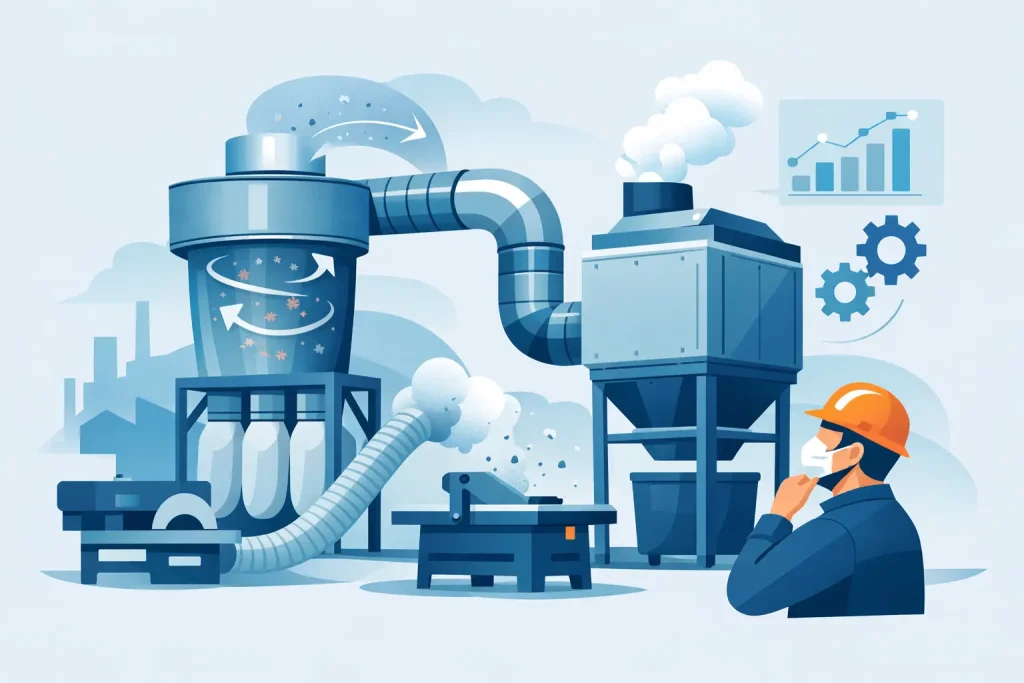
A dust collector that looks adequate on a layout drawing can still fail the plant the moment production ramps up. Airflow drops at the farthest pickup point, filters blind too quickly, dust settles back into the workspace, or emissions data cannot support a regulatory review. That is why industrial dust collector design cannot be treated as a catalog selection exercise. It has to be engineered around the process, the dust, the duty cycle, and the compliance standard the facility is expected to meet.
For plant managers, EHS leaders, maintenance teams, and project engineers, the real question is not simply which collector to buy. The question is whether the full system will maintain capture efficiency, stable pressure, service access, and defensible performance over time.
Why industrial dust collector design is a system decision
A dust collector never works alone. Its performance depends on hoods, duct routing, fan selection, air volume, filter media, discharge arrangements, explosion risk controls, and the way the production process actually behaves shift after shift. If one part is mismatched, the collector may still run, but it will not run well.
This is where many projects go off course. A design may be based on nameplate airflow without accounting for simultaneous pickup demand, duct losses, sticky or fibrous material, temperature swings, or changing particle loading. In those cases, the collector becomes a maintenance problem instead of a control solution.
A sound design starts by identifying what must be controlled. Fine powder behaves differently from metal grinding dust. Food processing dust may present hygiene and combustible dust considerations. Thermal process emissions may combine particulate with vapor or odor issues, which can change the selection entirely. In some facilities, a pulse-jet dust collector is the right answer. In others, a cyclone pre-separator, scrubber, or a staged system is the better engineering choice.
The process data that should shape the design
Before equipment sizing begins, the process must be characterized with discipline. This means understanding the source of generation, the rate of dust release, particle size distribution, bulk density, moisture content, temperature, and whether the material is abrasive, hygroscopic, sticky, or combustible. These are not minor details. They determine pressure drop behavior, hopper discharge performance, and filter life.
Air volume is another area where assumptions become expensive. If the design airflow is too low, capture suffers and worker exposure rises. If it is too high, transport velocities may become excessive, energy use climbs, and useful product may be pulled out of the process. Good engineering aims for the capture velocity required at each source while keeping the whole network balanced and maintainable.
Static pressure should also be treated carefully. Long duct runs, multiple branches, elbows, dampers, and dirty filter conditions all affect the fan duty point. A collector that performs well on a clean system curve may struggle badly under loaded filter conditions if the fan margin is too narrow.
Hood and duct design often decide whether the collector succeeds
Many dust collection issues begin at the pickup point, not at the collector. If the hood does not capture contaminants close to the source, the rest of the system is trying to recover from a weak starting point. Hood geometry, placement, and operator interaction matter as much as rated collector capacity.
Duct design also deserves more attention than it usually gets. Poor branch balancing can starve remote points. Oversized duct can let dust settle out. Undersized duct can create excessive pressure loss and wear. For abrasive materials, duct routing and material selection may need to reduce erosion at high-impact points. For sticky dusts, cleanout access becomes essential.
Choosing the right collector technology
Industrial dust collector design should never begin with a preferred machine and then force the process to fit. The dust and operating objective should decide the technology.
Pulse-jet bag filters are common because they handle high volumes and continuous-duty applications well. They are often suitable for dry particulate in manufacturing and bulk handling environments. But even within this category, filter media selection, air-to-cloth ratio, pulse cleaning strategy, and hopper design can change results significantly.
Cyclones and multi-cyclones can work well as primary separators for larger particles or as pre-cleaners ahead of a secondary filter system. They reduce loading on downstream filters but are not usually the right stand-alone answer for fine particulate control when strict emission limits apply.
Wet scrubbers may be more appropriate where dust characteristics, temperature, or combined gas-phase contaminants make dry filtration less suitable. The trade-off is that they shift part of the control burden into liquid handling, wastewater management, and corrosion considerations.
Electrostatic precipitators may fit specific fine particulate applications, especially where gas volumes and particulate characteristics support that approach. The point is simple: technology selection should follow process reality, not habit.
Filter selection is not a purchasing detail
Filter media is one of the most underestimated parts of industrial dust collector design. Standard media may be acceptable for some dry dust applications, but high temperatures, oily aerosols, fine particulate loading, and moisture exposure can demand more specialized materials or finishes.
The right media improves cleaning efficiency, extends service life, and helps maintain stable differential pressure. The wrong media can blind early, release dust, or create chronic downtime. Pleated elements, traditional bags, antistatic media, membrane-laminated options, and temperature-rated fabrics each have a place. The correct choice depends on the actual duty, not a generic specification.
This is also where compliance and maintenance objectives meet. A system that technically captures dust but requires frequent shutdowns, difficult changeouts, or inconsistent cleaning will not support long-term operational reliability.
Compliance has to be designed in from the start
For regulated facilities, dust collection is not only about housekeeping or visible cleanliness. It is part of the plant’s compliance position. Emissions performance, worker exposure control, and documentation all matter.
That means design should account for testing and commissioning requirements, stack sampling access, inspection points, instrumentation, and the ability to verify that the system is performing to design intent. If local regulations or permit conditions require specific limits or operating records, those expectations should shape the design package early.
In practice, this often separates a true engineered solution from equipment supply alone. A collector that is difficult to test, difficult to monitor, or difficult to maintain becomes a risk during audits, investigations, or internal reviews. Facilities operating under frameworks such as Malaysia’s Clean Air Regulations 2014 or DOSH-LEV requirements already understand this discipline. The same principle applies to any operation that needs defensible control performance and service records.
Monitoring and after-sales support matter more than many specsheets admit
A collector is not finished when it is installed. Differential pressure trends, fan performance, compressed air quality, hopper discharge reliability, and filter condition all influence whether the system keeps meeting design expectations months later.
This is where performance monitoring and service readiness make a measurable difference. Online monitoring, alarm logic, and routine auditing help teams catch declining suction, pulse-cleaning faults, or abnormal pressure conditions before they become compliance events or production interruptions. Spare parts availability and field servicing also deserve weight during vendor evaluation because they directly affect downtime exposure.
At Master Jaya Group, that lifecycle view is central to system delivery, from engineering and in-house fabrication through testing and commissioning, stack sampling support, auditing, and ongoing performance visibility.
Common design mistakes and their cost
Most underperforming systems trace back to a short list of design errors. One is underestimating dust loading and sizing the collector too tightly. Another is copying a previous project without rechecking the actual process conditions. A third is ignoring maintenance access, which turns routine service into a shutdown event.
There are also more subtle failures. Hopper angles may be inadequate for material flow. Rotary valves may be selected without considering the dust’s bridging behavior. Compressed air supply for pulse cleaning may be unstable or contaminated. Fans may be selected too close to the edge of the duty curve, leaving no resilience once filters load.
Each of these problems raises operating cost in a different way. Some increase energy use. Some shorten filter life. Some create recurring cleanup and exposure issues on the plant floor. Some lead to failed performance expectations during commissioning.
What decision-makers should expect from a design partner
A capable dust collection partner should ask process questions before discussing model numbers. They should review source capture, material behavior, fan curves, duct velocities, filter media, access for maintenance, and the compliance documentation the facility will need later. They should also be prepared to support field auditing, testing and commissioning, and post-installation troubleshooting.
That level of accountability matters because dust collection performance is rarely determined by one component. It is determined by engineering discipline across the whole control chain.
The best industrial dust collector design is not the one with the largest housing or the lowest initial price. It is the one that keeps capture stable, emissions controlled, maintenance predictable, and compliance supportable long after startup day has passed. If a system can do that consistently, it is doing the job your plant actually needs.